Description
Information Content of Forms
Despatch by TDOC
Receipt by Recipient
Full communication
cycle
EDI (Electronic Data Interchange) is a mechanism to speed up communications between people who use disparate and separate electronic systems. It is infinitely preferable to allow each party on a project to use the system they prefer rather than to force them to use "a project specific" system. Electronic Data Interchange is exactly what it says. It enables information to be sent from one system to another where the recipient can import and verify it with minimal effort.
An EDI is simply a text file with a structure which can be parsed to obtain the necessary information. There are no standards covering CEMDC (Construction Engineering Management Document Control). XML is one form of EDI consisting of text files in a specific format but this additionally requires the schema to be "published" so that the recipient can decode what is received. Attachments may accompnay the EDI so it is suitable for formal transmission of documents as well as just information. When it was operative the CITE (Construction Industry Trading Electronically) published a number of rules: one of these was that an EDI should be be "Human Readable". This tends to preclude XML which for complex transactions of the sort necessary in CEMDC cannot be construed as readable.
TDOC supports EDI for the following formal transactions:
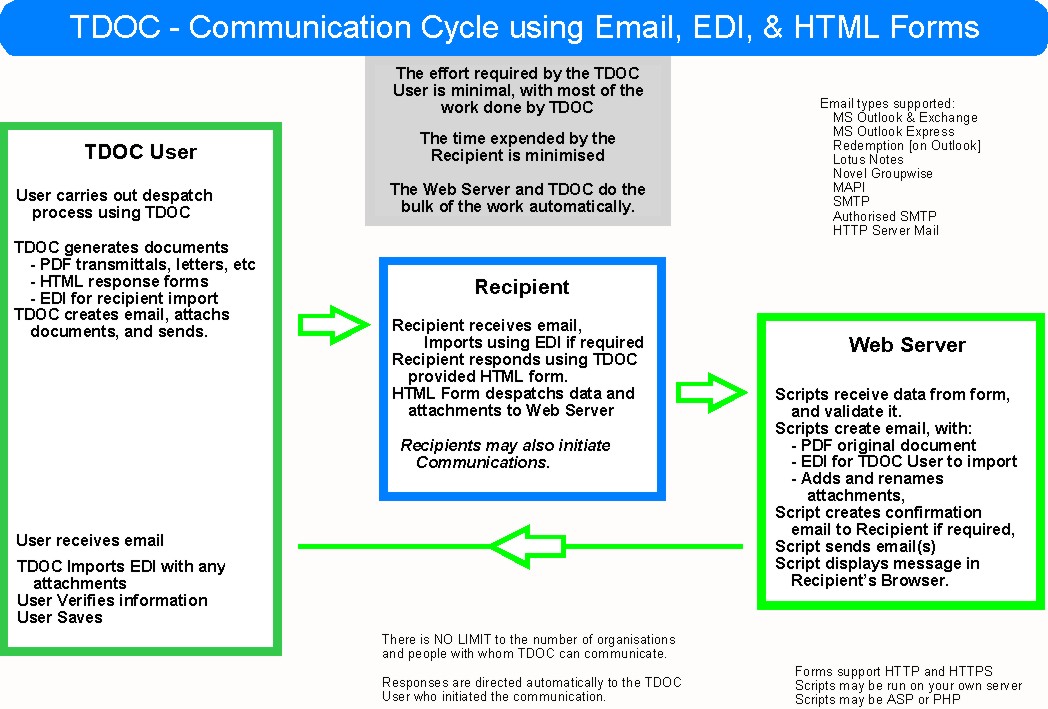
In order to enable transmission between a TDOC User and someone who only has access to the internet, TDOC generates an HTML form which when completed and sent [via an internet server] generates an EDI back to the TDOC User. This simple methodology ensures the operability of what might be termed "one sided EDI".
The forms may be previewed, exported, or emailed to the recipient for their use. When the form is generated, it includes a considerable amount of embedded information which is what ensures that the effor in processing the form may be automated to generate an EDI which can be easily imported. Information includes the following:
When a document is generated and despatched by TDOC using email, three things happen:
The email includes all of the generated documents as well as any transmitted documents, so the recipient can then decide how they wish to respond.
Recipients have a number of choices when receiving a document by email, and these are:
The same options exist for the a TDOC User on receipt of a response. The EDI import is the easiest and fastest option as long as the recipient has used either a compliant system or the HTML form to make their despatch.
The full communication cycle consists of the following steps