
WHY Cathcart

Why Cathcart ? or "By Cartha's Side"
To Evelyn
Who wanted to know if the Castle ever had a roof, who "lived there, when, and why "Cathcart"?
Here are the replies, somewhat belated, to those questions asked by my daughter when very young.
I could not answer them truthfully at the time and resolved to find out.
Who wanted to know if the Castle ever had a roof, who "lived there, when, and why "Cathcart"?
Here are the replies, somewhat belated, to those questions asked by my daughter when very young.
I could not answer them truthfully at the time and resolved to find out.
The result has been a fascinating and absorbing hobby. "Topophily", meaning love of a place is a word coined light-heartedly by an author who writes on local history in general. As a topophilist I offer this story of Cathcart simply to keep alive the memories of the past.
Jean Marshall 1969
Published by [Vista Logo] VISTA STUDIOS, GLASGOW, 534 Sauehiehall Street, Glasgow C.2.
[And when proof reading the OCR'd results we identified that some of Vista's typewriters were on the way out. One had a lowercase "l" which appears as a "Z" - others are normal wear and tear.]
A Note.
To everyone who reads this, we are endeavouring to preserve Jean Marshall's wish to keep alive the various memories she has so well described, and indeed to bring it up to date ... that in itself will be an ongoing project.
Introduction
He could for hours entertain his friends with reminiscences of of days when Cathcart was a 'clachan' and Mount Florida and Crosshill were not; when an omnibus ran twice daily between Glasgow and Busby serving Cathcart en route.
He dearly loved the village and spoke almost with regret (but certainly with no bitterness for he was sensible enough to recognise that the old order changeth) of the change from a sweet country place to the present 'town' with its rows upon rows of Villas, to say nothing of tenements.
Form the "Weekly Herald - August 1902
These words were said of old David Lindsay, the late owner of the "Snuff Mill".
Remembered today by some of the older generation he provides. a link with last century when in 1812 his father took over what was once the community meal mill, converted it into a prosperous paper mill and so made his contribution to a village slowly becoming aware of increasing trade and opportunity.
At a quicker pace, Cathcart developed from a residential suburb to a small town, and by 1912 had become part of a great city with the exception, that is, of the narrow strip on the eastern side of the parish retained by Renfrewshire.
The sweet country place was all that poets & writers claimed but more than rural charm accounted for its growth. Cathcart lay on the direct route between Glasgow and the South, and as new improved roads were opened early in the nineteenth century this doubtless attracted "outsiders" like Mr Lindsay to settle here - influenced by other reasons too.
The pure water of the River Cart was an important factor and brought the attendant industries of paper-making and dye-works to Cathcart itself, calico printing to Netherlee, bleaching to Newlands and cotton spinning to Pollokshaws. Weaving and farming had been carried on for centuries beforehand. Cathcart covered part of the great coal basin which extended from Campsie Hills in the north to the Cathkin Braes in the south and a small coal seam was opened here. It was either exhausted or abandoned as unprofitable soon afterwards.
In 1886 the new Cathcart District Railway brought more people - the first commuters perhaps? - ftom the city and elsewhere to enjoy living in picturesque and romantic Cathcart. It could be said that 1886 was the beginning of an era in local history as it was also in this year that the firm of G & J Weir established themselves on a mere half acre of ground. Since then, the world-renowned engineers have played a large part in the economy and life of Cathcart.
Although Glasgow's tobacco trade boom with America was over, the Lindsay Mill at the side of the Old Bridge tried a new venture, the manufacture of snuff - but only as a sideline, their main product being cardboard as used in book-binding. Came the machine age and, whether unable to keep abreast of the times or due to the decline in the cotton industry as far as Glasgow was concerned, several local firms closed down, among them being Geddes Dye-Works and Carpet Factory, Cathcart Creamery, Verel's Photographic Works and the Cassel (Castle?) Gold Extracting Company, the latter with a title likely to arouse interest if not speculation. On the site of these small firms Weir's have gone from strength to strength.
Tenements replace the cottages where the workers from Geddes and the Creamery lived. Newlands Road was unknown; instead, the grey-stone blocks of houses were called Holmhead Park, Holmhead Street, Crescent and Terrace, etc.
But how did Cathcart appear even before that?
A 17th Century account of dwelling houses here was to the effect that, while mainly all of "but-and-ben" type, the family lived, in the "but" while cattle occupied the "ben". These houses were turf roofed, primitive and insanitary, although not hovels as were the houses of Langside at the time of the Battle. The parishioners went about armed and led a hand-to-mouth existence.
A very different picture is portrayed in the Statistical Account of 1845 when Dr Smith, the Parish Minister,informs us, "There are now plenty of farms, the main crops being potatoes, wheat, oats, etc". Ironstone was plentiful on the estate of Linn, the river was well stocked with trout and along the banks of the Cart were scenes of romantic beauty. "As for the villagers, their conduct is good, about thirty paupers on Poor Roll each receiving about five shillings per month". More should have been entitled to the latter but with true Scottish traits were too proud and independent to admit their plight and have names entered on the Poor Roll.
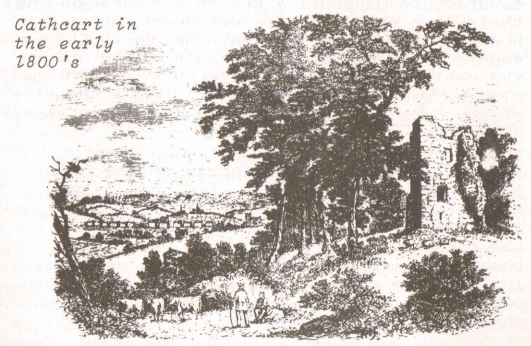 A few years later, Hugh McDonald wrote "Rambles Around Glasgow" and, when visiting Cathcart, described the old village as somewhat irregular and scattered, consisting of around 20 houses each with its own trim garden patch; also a handsome farm steading, a smithy, a snuff mill, an extensive paper factory in the neighbourhood and two public houses. He made no mention of any other shops, only that the landlord of one of these "refreshment houses" made it so comfortable and attractive that city dwellers "even with all the comforts o' the Sautmarket" enjoyed regular visits.
From the Castle the author proceeded over the Old Bridge into New Cathcart, described as "a neat and tidy-looking village lying about one third of a mile to the west and being of modern origin it possesses few features of interest"! So much for the l850s. (Perhaps it should be made clear that these rambles in their original form are beautifully described and the extracts quoted in no way do justice to Mr McDonald).
A row of one-storey houses between Delvin Road Bridge and Hawthorn Lodge, one of which was Gilchrist the weaver's shop where blankets were made and sold, is one of the tales handed down to us. Another is of the road leading to the Castle being the original "Rhannan" while the one we know as such today was called the "Wee Rhannan". The construction of new roads often alters the contours so much as to make many a place beyond recognition.
When David Lindsay died in 1902, the paper mill died also. His cottage home, situated between the mill and the entrance to the Linn Park, was replaced by a villa. Lindsay House which he had built in the grand manner yet never enjoyed was converted into a tenement. By one month he missed seeing the first electrically powered tramcar journey along Holmlea Road constructed especially for this purpose. In fields where Holmlea School and the buildings of Tulloch and Rannoch Streets now stand, Farmer
Peddie's cows continued to graze oblivious of this new mode of transport and of the city creeping up on them. For a time the city boundaries had halted at Mount Florida and Langside, but in 1912 Cathcart and Newlands were absorbed into rapidly expanding Glasgow.
In 1920 the columns of a local paper reported fifteen pheasants counted at one time in a field adjoining the Parish Church. Before ten years had elapsed, vast new housing schemes were spraw11ng over farm and parklands.
Today every spare piece of ground is utilised. Instead of the old style of tenements, luxury flats are the newest feature and towering in the background are the multi-storey or high-rise flats.
Little remains of the rural atmosphere and distinctive character of the village. The author of "Notes on Cathcart District", even in 1888, knew what he was talking about when he said, "We may expect encroachments upon the rusticity of the place until all that is quaint and distinctive has disappeared. Such are the inevitable drawbacks which attend our advancing civilisation" .........Such indeed!
Fortunately, there are some buildings and landmarks left to remind us of our historic and interesting past. Although in decaying condition, all withstood the January hurricane of 1968. Nevertheless, the ravages of time or of "progress" must see them disappear from our midst.
All things pass, the River Cart flows on .....
Ch 1. Cathcart WHY ?
When visiting strange places most of us show some interest in local history by looking over castles, churches, museums, etc. We study guide books and expect local people to tell us of the district and its past. Yet at home how many of us are content to remain ignorant of our own environment and historic development?
Then again, quiz competitions are popular on radio and television. If Jack House were to set the questions of an inter-district brains trust and ask, for example,
- The meaning of "Cathcart" ?
- Who lived in Cathcart Castle ? or,
- As an observation test: How many bridges are there over the River Cart in this area ?
Would these answers have to be inspired guesses because you too have perhaps been disappointed in your quest for books about your locality?
Historical documents and church papers provide us with the vital clues. Reference books, mainly in libraries such as the Mitchell, press cuttings and auld wives tales (as well as auld men's) all contribute to this, a story of Cathcart.....
Last century saw a heartless destruction of several items of historical interest in and around Glasgow by those who cared neither for the past or the future. Cathcart suffered the loss of an ancient well which was filled in when an extension was made to the churchyard cemetery. Known locally as the Kirk Well, it was in fact the beginnings of the Christian Church in Cathcart. Situated in the south-east corner of the graveyard, st Oswald's Well, to give it its proper name, became sacred through association with Christian baptism. The Parish Church was also dedicated to St Oswald - but more about this in a later chapter.
At the other extreme, it is also on record that the sacred nature of the well did not deter the publicans from the Gorbals who used this same pure spring water to mix with their supplies of the "mountain dew". Of course there is no hint or suggestion in this report that local public-house keepers indulged in such practices .....
Kirkwell gave its name to a farm steading since removed. Now a road of that name is the only reminder.
Before the twelfth century, much of the story of Cathcart and elsewhere for that matter is conjecture, but here and there are given facts which, like stepping stones, lead us to firmer ground. Cathcart was part of the Kingdom of strathc1yde, in a wild tract of country much of which was bog or marshland. The inhabitants were Britons, a Celtic people who spoke a primitive Welsh closely allied to Gaelic.*
In 1124, David I became King of all Scotland and so began a relatively peaceful spell. It was also that formative period when a superior system of order and administration emerged, parishes were mapped out, abbeys and monastic houses were founded and a start was made to reclaim and cultivate the land.
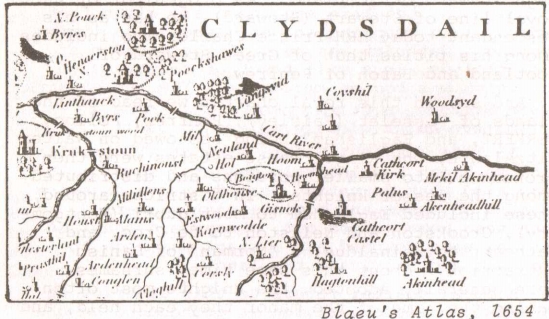
A royal charter refers to this district as KERKERT, no doubt written as pronounced by the common people of that time and thought to be from "caer" the Celtic word (some prefer to say British word) for fort on the "cart", a fertilising stream.
Therefore, it seems that the Castle or probably an older fortress on the same strong, rocky position, gave Cathcart its name, but as so often happens opinions differ. From "Views in Renfrewshire" we are informed that, "Cathcart signifies strait or confined part of the Cart and, as the river here runs in a confined channel between rocks, this description is strictly applicab1e".
Each explanation is applicable. It can be argued that the village was here before the castle - the Parish Church dates from the ninth century - but no-one can say for certain when the castle was built. As the present stone structure is believed to have replaced some other type of fortification, there is no reason to discount the "Fort on the Cart" as the meaning of KERKERT.
Throughout the years we find this name spelt in a variety of ways - Ketkert, Kethkert (which has a decidedly "Kelvinside" ring about it), Carcart and Caethcart before taking its final form.
 What of the common man? His role of serf was an unenviable one, being passed from owner to owner without choice - a life very different from that of his feudal superior. The story of Walter FitzA1an is perhaps too well known to be repeated but, if history was never a strong pOint, to remind you it was this: in fighting times the King required fighting men. David I had spent much of his youth in England and knew many "Norman" knights. He admired them and respected them as they were good administrators and professional soldiers - if thev trained and led his Scots in battle, he would have a very strong and powerful army. The result was that in 1141 several "Normans"* either accompanied or followed the King back to Scotland, de Brus and FitzA1an being the best known.
Walter FitzAlan was one of a dominant Shropshire family of Breton descent and claimed kinship here with people of his own race. High in the King's favour and for services rendered, he was given vast estates in Renfrewshire and Ayrshire along with the appointment of First High Steward of Scotland. As progenitor of the royal line of Stewart (Steward), he has as his descendant today HRH Prince Charles who includes among his titles that of Great Steward of Scotland and Baron of Renfrew.
And so, in this royal charter we read of the "lands of Passe1et (Paisley), Renfrew, Polloc, KERKERT, and Eaglisham" being bestowed on Walter FitzAlan by the King. These estates were then broken up into smaller portions and distributed among the lesser knights. In districts around, these included Eag1esham to Mont'gubri (Montgomery), Crookston and Neilston to de Croc, and Cathcart to Rainaldus, a "Norman" of Danish extraction. About this same time, surnames were generally adopted, the knights most often taking the name of the manor they each held, and so we read of Rainaldus de Ketkert, a story to be continued in our next chapter.
Cathcart was one of the three ancient parishes which ringed Glasgow to the south, the other two being Govan and Eastwood. The parish of Cathcart also consisted of the Manor of Le Drep, later called Dripps (by ThorntOnhall and Waterfoot and now in East Kilbride Parish). In the early 15th Century when Renfrewshire was separated from Lanarkshire, Cathcart was drawn into the latter county and subsequently into Glasgow. No without opposition, however - as far back as 1869 protests against this move were made by spokesmen from the various lands within the parish. In the torchlight processions that followed, no doubt their chant would be the equivalent of "We shall not be moved"! Only that little strip on the eastern side of Cathcart approximately three miles by one remains outwith the boundary, claimed always by Renfrewshire.
Now the parish exists virtually in name only, as can be judged by the wide area it includes - Mount Florida, Langside, Croashill, Newlands, Muirend, Clarkston, the maJor part of Crossmyloof and part of Pollokshaws.
Before we leave the twelfth century, however, there is the important connection between Cathcart Parish Church and Paisley Abbey. In an age of religious fervour, this was the time when the King founded abbeys and monasteries in various parts of the country, the lovely ruins of many of which remain today. In fact he so depleted royal revenues that it earned him the description "ane sair sanct for the croun". The great barons followed their royal master's example of pious generosity possibly for two reasons: the gift ensured the welfare of their souls and those of their families in the world beyond, and monasteries were economic necessities be1ng centres of farming, culture and hospitality.
Walter FitzAlan brought 13 monks of the Cluniac Order from Wenlock in his home county of Shropshire te found a cOlony on the banks of the Cart which we know today as Paisley Abbey. Since no mention is made of a church being built at Cathcart we may assume that when the land was granted to FitzAlan he found one already in existence which was in fact the Celtic church of Cathcart. In 1179 there is recorded in the Abbey register a deed of gift of Cathcart Parish Church by Alan, son of Walter, now Second High Steward, and witnessed by Rainaldus de Ketkert. Again, it was the fashion and practice of wealthy medieval Christians to donate property to the Church. The most common gift was a small parish chUrch with its lands and tithes. In all some 13 churches were bestowed on the Abbey making it one of the richest in Scotland for a time. The Cathcart Pillar was donated much later.
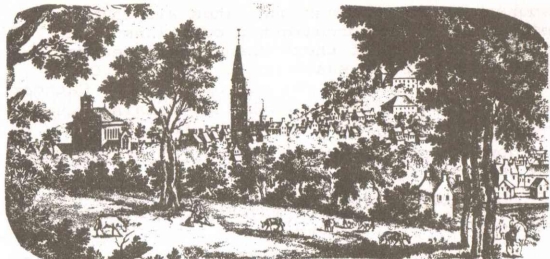 We can see now, perhaps, how the twelfth century shaped our background. On our own doorstep so to speak there was this perfect example of the feudal system - the King granting lands to FitzAlan who in turn divided them amongst his knights - all duty bound to serve their lord in battle. Parishes were established, and Paisley Priory' (later raised to the rank of Abbey) presided over Cathcart and neighbouring churches, a system which led to faults. Sad to say, wehave no church records until after the Reformation. The monks of Cluny were reputed to be the finest farmers in Europe and, possibly due to their gUidance, this area became in time one of rich and fertile fields where only woods and marshlands had formerly existed.
We pass next to the family who took the name of Cathcart and to the Castle which in those early days would offer protection to local inhabitants (Kerkertians or Kethkertonians?) later to live in low thatched or mud-built dwellings along the banks of the Cart, forming the village we refer to as Old Cathcart. In the followinq three or four centuries the fortunes of those families placed around this area by Walter FitzAlan underwent many changes. New families were introduced among them, the bride's dowry or "tocher" not unimportant to the marriage settlement.
The Cathcart Family suffered a severe setback in the 16th Century, and for the next 200 years the Semples owned most of this district. Like the Cathcarts, the Semples have a long family lineage.
Many famous people have trod these paths, among them William Wallace, if we are to believe the poet Blind Harry who tells us that the great Scottish patriot was very fond of the Mearns area where he found himself in "a skirmish with Lord percy's men, and they took the horse belonging to Wallace's uncle, the Sheriff of Ayr, Sir Reginald Crawford. Wallace reported this news to him but the Sheriff, treading warily, told his nephew to take it easy". This was too much for Wallace who set off in hot pursuit, overtook the thieves near Cathcart, and slew them all". For this, Wallace was outlawed.
So, from Wallace we think of Bruce and learn of his devoted friend, Sir Alan Cathcart .....
* FOOTNOTES
According to Nora K. Chadwick in "Celtic Britain", there is no Celtic race, tribe or area, the term being a linguistic one.
The direct descendants of those who followed in the wake of the Conqueror were all described as "Normans".
Ch 2. The Castle (or The House of Cathcart)
The House of Cathcart has continued in unbroken line from the twelfth century, which in itself must be unique. Beginning with Rainaldus who has been introduced already and who first took the name of Ketkert, presumably this was the family who occupied the Castle and owned the surrounding estate until 1543 when Alan, third Lord Cathcart, became involved with the "troubles of the country" and was forced to sell the property.
Not until 1801 was it repossessed by the Cathcarts,and by this time the Castle was uninhabitable. The Earl(s) then lived in nearby athcart House, but in 1921 left the area to take up residence in the south. Understandably, local interest in the family has waned since then but their many distinguished military and diplomatic posts are worth recalling.
For example, the first Earl, like his predecessor, was Ambassador to the Court of Russia at st Petersburg (1812-1821) and, according to a present day local worthy, Andrew Murdoch, (a veritable mine of information on Cathcart's vital statistics) the success of the Battle of Waterloo was due not only to Wellington but to our man from Cathcart, the first Earl !
Certainly his career was brilliant. He entered Lincoln's Inn and in 1776 was admitted as an advocate at Edinburgh. He acted as military adviser to German and Russian generals, and his diplomatiC services earned him high Russian decorations. For decisive measures employed to obtain the surrender of the Danish Navy, he received the thanks of both Houses of Parliament and was received in audience by the King. He married an American lady who became Lady-in-Naiting to the Queen and later Mistress of the Robes. She died at Cathcart House.
Their son William, the Master of Cathcart, Captain RN, appears to have been the only one who favoured the senior service. He died at Jamaica when only 22 in command of HMS Clarinda His brother Charles became the second Earl of Cathcart and in 1846 was Governor General of Canada. He was the author of several papers in geology, and discovered a mineral called after him - "Greenockite" - found in rock when the Paisley to Greenock railway line was under construction. A yellowish crystal, it is still used in photo-electric cells but no longer found here.
The family can be traced back (from Scots Peerage) as follows:
Ranalfus succeeded Rainaldus but these may well be one and the same as both names are early Danish. In 1296, William de Kethkert added his signature to the Ragman Roll (the list whereon Scottish Kings and Nobles vowed allegiance to Edward I of England). Sir Alan Cathcart who followed was a devoted friend of Robert the Bruce and gave effective support in maintaining the independence of his country. He seems to have been all that a knight should be - described in a poem by Barbour, a poet of the 15th Century who knew him well as "worthy and wight, stalwart and stout, courteous and fair, and of good fame" .....
Further lands were granted and in 1447 the new Sir Alan, great grandson of Bruce's companion, was raised to the peerage. Five years later King James II granted a charter erecting the lands of Cathcart, Talgart (Tankerland), and Bogton to be called the Barony of Cathcart. Sir Alan's name frequently appeared as a witness to charters of this period and so it could be inferred he was in close attendance upon the King. He lived to an advanced age and died in 1497.
Of particular interest is the fact that in 1543 or 1546 the third holder of the title became involved with the "troubles of the couhtry", a quaint way of expressing the all too familiar phrase of being "hard up". He sold his property to his Lady's uncle, Gabriel Semple. The castle and certain lands of the parish were then transferred to the Semples whose descendents continued as proprietors and resided in Cathcart for the next 200 years. (A "History of Renfrew" points out that this Gabriel Semple and his wife Janet Spreull assumed the name of Cathcart which remained in their family for some time, but this is not confirmed elsewhere).
Three members of the House of Cathcart were slain at Flodden and one at the Battle of Pinkie. Then, remembering the times in which they lived, we find Alan, fourth Lord Cathcart, along with Lord Semple fighting one year for the Queen, yet later in 1568 fighting against her at the Battle of Langside. Sir Alan was a great promoter of the Reformation and signed the bond on behalf of the young King James VI.
Charles, Lord Cathcart, distinquished himself at Sheriffmuir where the vi~tory over the left wing of the Insurgents was principally owing to his efforts. He was the third ,husband of a lady who in those days caused some comment.
The motives behind her four eventual marriages were said to be
- to please her parents,
- for money,
- for title, and
- here, the romantic might add, for love!
However, her fourth husband, an Irish officer, thought the devil owed her a grudge and would punish her for her sins, so he kept her a prisoner at his Irish home for TWENTY YEARS! She was freed only by his death and lived to the ripe old age of 98 (there is no mention of her entering upon matrimony for a fifth time).
At the time of the '45, the next Lord Cathcart was ADC to the Duke of Cumberland and was High Commissioner to the General Assembly. In 1768 he was appointed Ambassador to the Court of Russia for three years and it was his successor who, as already described, gained so many honours and decorations. Lord Cathcart was created Viscount in 1807 and became the first Earl in 1814. It was he who bought back the Barony of Cathcart from John Maxwell of William-wood who had bought it previously from the Semples. After a lapse of 200-300 years, this portion of Cathcart had returned to the direct male heir of its ancient owners. The Earl later acquired another portion named Symeshill.
The Cathcarts were therefore present at such famous battles as Loudon Hill, Bannockburn, Flodden, Pinkie, Langside, Sheriffmuir, Waterloo and at the Crimean War in particular at the Battle of Inkerman where Sir George Cathcart GCB (fourth son of the first Earl) was killed and buried near his division's encampment on the heights overlooking Sevastopol, still known as Cathcart Hill. His name is commemorated in the title of the local masonic lodge, viz. "Lodge Sir George Cathcart".
The name continues in true army tradition. The present Earl joined the Scots Guards in 1939, commanded the Ist Battalion 1957-59 and the Regiment from 1960-62. As Brigadier he commanded the 152 Highland Infantry Brigade from 1965-66. As the sixth Earl, his son and heir is, Lord Greenock.
Now we know why there is an avenue of that name alongside the Castle. It is a pity that the title holders of such long historic connection are unknown in the area to which they belong.
Next, let us find out what we can about the Fort on the Cart, where Nature is left to do what man could not .....
Ch 3. All about the Castle
When or by whom it was built is lost in antiquity. Undoubtedly the oldest building in Cathcart, it is generally believed that another castle or fortress preceded it. In the twelfth century castles were made of wood, stone being too expensive and reserved for churches, but in this area there was always a plentiful supply of stone, making it difficult to determine when exactly Cathcart Castle was built - 13th, 14th or 15th century?
Consider its position. Standing on high ground, it must have possessed great value as a place of security and strength, two of its sides being completely defended by the Cart.
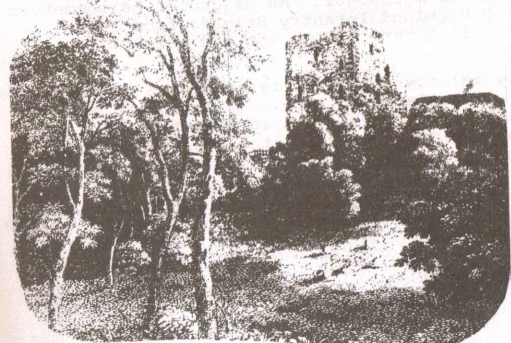 Only the keep remains, but a survey carried out in 1866 showed that the keep had five storeys and was surrounded by smaller buildings. The walls are ten feet thick in places, a splendid example of the way buildings were erected centuries ago. There is an excellent model of the castle in the People's Palace, Glasgow Green, which gives a much clearer idea of how it all must have appeared in those far-off days. Certainly its situation and style agree with "Norman" castles built in the 13th Century.
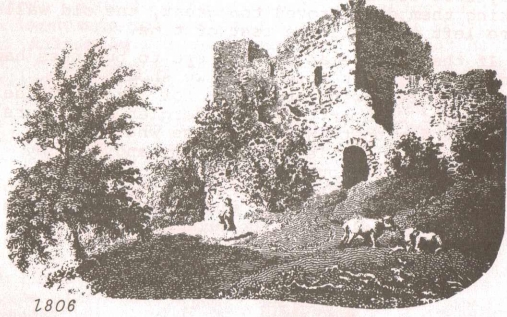 At the time of the decisive Battle of Langside the castle belonged to Lord Semple who, with Alan, fourth Lord Cathcart, fought against the Queen. This gives rise to that debatable point as to whether or not she stood so near her enemy, on Court Knowe, on that fateful day, 13th May 1568. In defence of this argument we should bear in mind
- the Semples and Cathcarts like many other Scottish families of those times frequently had representatives on both sides,
- although the Semples were in the main Protestants, the head of the family Lord Semple remained Catholic and confusion could easily have resulted,
- on the day of the battle the Queen would know that the Castle would be deserted except for female occupants and so would feel reasonably safe with her bodyguard, and
- the Queen, alas, was neyer renowned for her good sense. Court Knowe and Langside are dealt with in a later chapter.
The castle was abandoned as a dwelling about 1750 and sold to an enterprising man who thought he could make his fortune by using the material for building purposes. His tradesmen removed the roof and proceeded with the walls to find they were too solidly built. As the expense of taking them down proved too great, the old walls were left to stand the test of time.
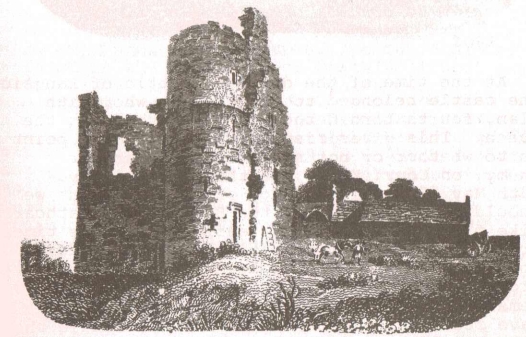 If that gentleman with an eye to business had had his way, just think what we should have missed, not knowIng or seeing for ourselves the origins of Cathcart. Our Rutherglen neighbours are less fortunate with no trace whatever of their ancient castle - fought for and held by Bruce, partially burned down as an act of vengeance by the Regent Moray because it belonged to the House of Hamilton, and then through decay eventually levelled to the ground.
Should this be allowed to happen to Cathcart Castle?
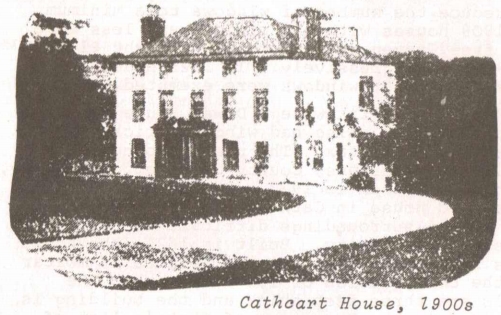 When in mid 18th Century it became uninhabited the Earl(s) resided in nearby Cathcart House which stood about 100 yards from the Linn Park entrance in Golf Course Road, and was one of three Dower Houses built originally for the widow of the late owner. Shortly after World War I when the Earl of Cathcart finally left this neighbourhood, Cathcart House was rented to various gentlemen but was demolished in 1927 by Glasgow Corporation who used the stone to make a rockery on the site of the house. Now the rockery itself has almost disappeared.
The older generation may remember two little cottages between the Castle and the road. In one lived the Earl's coachman and later the caretaker of the castle. In the other lived the Earl's gardener and grieve, latterly Mr Peter Craighead, a notable "pillar of the kirk". The cottages were pulled down also in 1927, the stables and outhouses having been demolished some years beforehand. They stood close to the side of Lovers Lone, less romantically known today as Golf Course Road. The trees here are worthy of note, particularly the beech at the former entrance to Cathcart House which is hundreds of years old.
One feature clearly remembered of this residence is of false windows painted on its walls; black with white frames similar to those seen today at the back of the Mansion House in King's Park. These "phoney" windows were introduced because of a tax which forced owners to reduce the number of windows to a minimum. In 1808 houses with six windows and less were tax free, seven windows cost £1, eight £1.13.0 and so on progressively. In 1825 houses with less than eight windows were exempted.
"Cartbank", likewise a Dower House in Netherlee Road, also had windows bricked up because of this tax. The present owner, Dr James Macfarlane, County Convener of Renfrew, "unbricked" them in 1937. It is the oldest inhabited house in Cathcart, a very beautiful one set in surroundings difficult to believe. to be so near the city. Built in 1621, the house does not look old due to the absence of mortar in the construction of its stonework. The walls are three feet thick and the building is, included in the Secretary of State's list of Buildings of Historical and Architectural Importance.
In the grounds Sir John Lavery in 1905 painted "A Game of Tennis" and had the picture hung in the Tate Gallery. The players were Sandy and Elizabeth McBride, former owners of "Cartbank". 'Alexander McBride was also an artist of no mean ability, his picture "Sweetheart Abbey" being hung in Glasgow Art Galleries.
Of the third Dower House today there is no trace.....
Ch 4. Churches
The Rev Dr McKellar, DD, the late minister of the Parish Church , used to say "there was no need to write about Cathcart, its antiquity was enough". With all due respect, one may ask what happens when the scene changes and there is little left to remind us of the past? Memories are short we soon forget.
One instance of this is the Kirk Well, or to be more correct st Oswald's Well. Its disappearance is to be deplored, as it was from this sacred spot that the Christian religion in Cathcart is reported to have been proclaimed over a thousand years ago. The word "Old" in the Old Parish Church emphasises this, a most solemn thought. Symbols found on tombstones were in use under the influence of Ninian, and apparently the ancient name of Kilmailing points to a church or cell (kil) of the followers of Ninian.
St Oswald the patron saint of Cathcart and to whom the church was dedicated, was a King of Northumbria held in great veneration by the Celtic Church [See Note 1]. As a youth he fled to Iona to escape slaughter and remained on this sacred isle or some time. He may have visited these parts, we do not know, but during the seventh century the Anglican Kingdom of Northumbria extended over Strathclyde. Before they left this area finally in the eighth century [See Note 2] there is every likelihood the Angles built a place of worship in honour of their dead king near the well or on the site of the old churches. In 1555 a Lady of Cathcart, Lady Spreull (wife of Gabriel Semple?) had a clause in her will that her "body be interred in the choir of St Oswald's" as the church was then called.
The Celtic Church was giving way to the Roman by the twelfth century. Tankerland, a very old spelling of the word "Taggartland" [See Note 3} meant in the Gaelic "priest's land" and it can be inferred that here was the land set aside and occupied by the priest of Cathcart. The Couper Institute and part of Papermill Farm (until ,recently at Lanqside and Newlands Station) were built on the 24 acres of Tankerland. Paisley Abbey supplied the priest or stipendiary whose poor stipend was scarcely enough to live on. Meanwhile, the wealth accruing from church lands and donations from over-generous and pious Christians helped to make the Abbey one of the richest in the land and which in time corrupted its original purpose. The parishes had become the Cinderellas of the medieval church - starved of tra1ned men and money for the upkeep of churches.
 When the storm of the Reformation broke in 1560 [see Note 4], it was not just a break wIth papal authority in Scotland but a genuine attempt to restore worship and teaching in every parish by trained men in the ministry and school, supported by local sessions which also administered a system of poor relief. Whatever the political and economic factors which lay behind the establishment of the Reformed Church in Scotland, we must never forget the evangelical zeal which sought to bring the knowledge and service of God and an understanding of the Scriptures to common people everywhere. Of course, the supply of ministers was quite inadequate, and Readers or Exhorters were temporarily employed. Not until 1568 did the first minister come to Cathcart Parish and it is interesting to note that from 1568 to 1968 a total of only 22 ministers spanned those centuries, a small number to cover such momentous times considering that one third of that total held office for only three or four years on average.
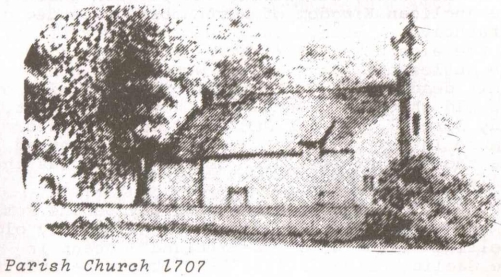
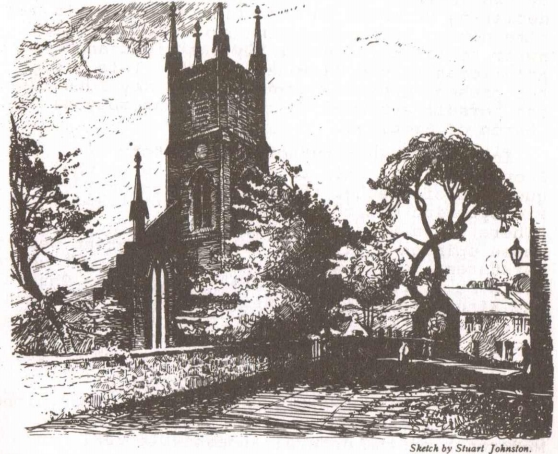
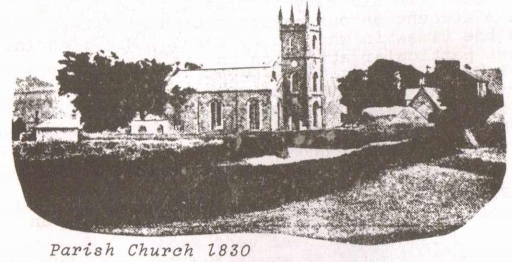 The first church we actually know about was a plain barn-like structure at the beginning of the 18th century with seating accommodation for 150 people. It was replaced in 1831 by the building many of us remember and of which only the tower and belfry remain. The bell continued to be rung from here until 1958 when it was transferred to the present church for reasons of safety. The remainder of the church had been pulled down in 1931, an elegant Gothic building seating 850. The same design had been adopted in churches at Mauchline and Cardross - the latter bombed during World War II leaving only the tower. Mauchline is still very much in use and, although built after the time of Burns, its walls overshadow the graves of many of the poet's home folks.
The foundation of the present church (architect H.E. Clifford) was laid on 25th March
1928 by the late Lord Tweedsmuir, better known to us as John Buchan, the author, who attended Hutcheson's Grammar School along with Dr J.A.C. McKellar. Although it is not the purpose here to indulge in sentiment by reminiscing over those gone from our midst, it is only proper that mention be made of Rev J.A.C. McKellar, D.D., who was a familiar figure to all in Cathcart. His ministry lasted from 1910 to 1957 when he retired. A splendid speaker, his voice could be heard in all parts of the church without the necessity of modern aids. Well liked by his parishioners, with his passing part of Cathcart seemed to go too. The Memorial Chapel remains a fitting tribute to him.
The Rev George Gilchrist, B.D., and Mrs Gilchrist now ably fulfil all calls on their services. In his very interesting and informative account on our parish church ministers and the times in which they served, Mr Gilchrist draws particular attention to the Carstares [see Note 5], father and son. John Carstares, A.M., in this parish from 1647 to 1650 eventually became minister of the High Kirk in Glasgow (The Cathedral) from which he was ejected by Charles II in 1663 and suffered greatly as a Conventicle preacher in the West of Scotland.
 His son William was born in the Manse of Cathcart in 1649 and was destined to become an important figure in national history. After graduating M.A. at Edinburgh University when 18 years old, he went to Holland as did many refugees from persecution at home. In 1688 he returned with William of Orange, and throughout the latter's reign acted as his chaplain and adviser on Scottish affairs.
It could be said that William Carstares was the Architect of the Church of Scotland by Law Established. He became Principal of Edinburgh University and one of the ministers of the town. It is clear from tributes paid to him by Queen Anne and her Counsellors that his skilful and patient leadership overcame the fears and hostility regarding the Treaty of Union in 1707.
The National Church's assent was only won over by the insertion of an entrenched clause declaring it to be an essential condition in all time coming that succeeding sovereigns should swear to maintain inviolably the right and privileges of the National Church. This pledge the present Queen renewed when, on May 20th 1969, she herself attended the General Assembly of the Church of Scotland.
In Hume Brown's authoritative history of Scotland he had this to say in reply to the question of whether the Episcopalian or Presbyterian Church would be set up in Scotland... "There was a Scotsman - William Carstares - to whose opinion William of Orange gave great weight; Carstares' advice was that William's wisest course would be to re-establish the Presbyterian Church and King William determined to follow it". Thus a son of the Manse of Cathcart played a decisive part in shaping the future development of Scotland's story, the consequences of which are being hotly debated in our own day.
Dr Smith was parish minister for the very long period of 68 years from 1828 to 1896. He was Moderator of the General Assembly in 1881, and was recognised as one of the leading authorities on church law. His remarkable memory aided his reputation as a conversationalist, and could recall a talk he had with a soldier who carried arms at Culloden. It is in items such as these that by-gone events become alive and real, especially when they touch our own district.
 The Kirk Session was regarded as a court and had powers to deal with social offences not within the jurisdiction of the civil courts. The task of the Kirk in the 18th Century was to promote certain standards of conduct in the community, and at best the discipline was an attempt to uphold these standards. Regardless of position, be they minister, elder, gentry, merchant, servant or labourer, all had to submit if erring. But in pre-industrial Scotland there were those who rebelled against the Church's moral sanctions, none more so than Robert Burns who in some of his finest poems hit out at the spying, admonishing and public shaming. Drunkenness, sexual offences and missing girls were all social problems then as now, only perhaps viewed in a different light.
Girls, missing from home, "believed to be in Glasgow"; somehow they were beyond the pale. No-one, it would seem, was prepared to bend over backwards to understand problem children in those days. Some light relief could be found in the incident of the parishioner who, like Tam o'Shanter, had imbibed too well 'in Glasgow and could not manage home to Cathcart. It was reported that "he was marred in his speech" and "fell off his horse betwixt Gorballs and Hangingshaws". He merited a sessional rebuke, as did another offender who was found helpless "not knowing whether his tongue would serve him for speaking or his feet would serve him for walking".
On the whole, though, the Kirk Session must have had the backing of the community or the system would not have worked. Cathcart was fortunate to have men of charity and commonsense.
Five other churches serve this district:-
- CATHCART SOUTH in Clarkston Road, founded in 1887, was originally a United Presbyterian congregation. The present minister is the Rev John L. Kent, M.A., D.D.
- NEW CATHCART in Newlands Road was a church extension of the United Free Church, founded in 1899. The minister is the Rev Samuel Aikenhead.
- The UNITED FREE CHURCH in Struan Road held services in the Couper Institute from 1929 until their church was built in 1931. Minister, Rev John Banks.
- The BAPTIST CHURCH in Merrylee Road existed as a church from 1923 until the building was consecrated in 1925. Minister, Rev B.S. Allsopp. In 1911 the Battlefield Congregational Church was formed and later secured a site at the corner of Holmlea Road and Garry Street. In 1924 it was renamed the CATHCART CONGREGATIONAL CHURCH and the present building was erected in 1935. Minister, the Rev J.C. Saunders.
- We cannot omit BATTLEFIELD EAST CHURCH, the original "Free Church of Scotland" in Cathcart, meeting as they did in a wooden hut attached to some works in the district from 1862. The grey stone part of this church in Cathcart Road was erected in 1865, the red stone building in 1912, to become known as Battlefield 'East' from 1929. Present minister, Rev Eric Milton.
The winds of change have indeed blown over Cathcart. The Roman Catholic community has also grown with the years, and the wooden church erected in 1935 was replaced by a superior stone building in 1960 with school adjoining, in Carmunnock Road.
The reconstruction of this quiet country road has levelled the "cuddy-killer" as it was known, and at the Mount Florida end the "elfit" or "elphet" brae. Carmunnock Road began originally at the King's Park Road and, with twists and turns, one fork led under the railway bridge in Holmlea allotments and on to the hump-backed bridge at McNeil's House, Clarkston Road.
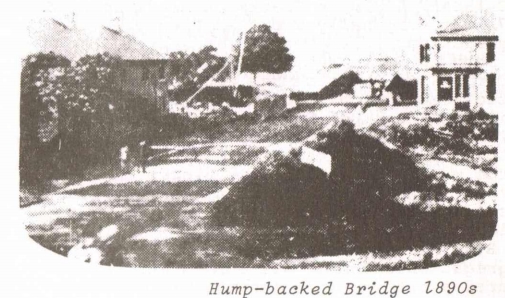 All that remains now of the old road to Carmunnock village is the pathway between the parish cemetery wall and the waste-ground we used to call the "sand-park". Last century this WaS the road that would take us by Peddie's Farm to the former manse and schools.
Footnotes:
- In 642 Oswald fell in battle fighting Penda, the champion of paganism
- "The Angles were later in leaving Ayrshire and we find in that county a parish church Kirkoswald, dedicated to st Oswald. The Anglican rule in the South of Scotland came to an end about year 803 and it is therefore unlikely that after that time any church would be dedicated" - A.M.Scott's Historical Papers
- It is in this spelling that it appears in a brown charter of land dated 1527. A.M.Scott
- Before the Reformation the Abbey had farmed out Cathcart tiend, doubtless to some favourite for the small sum of 40 pound Scots yearly. The tiend was drawn from cattle, fowls, eggs, milk, hay, lint fishings. A.M.Scott
- Elsewhere called "Cardinal" Carstares because of his influence on both church and state.
Taken from the Parish Church notice-board:-
CATHCART (OLD) PARISH CHURCH
Founded 9th Century attached to Paisley Abbey 1160-1560, disjoined from Presbytery of Paisley 1596.
MINISTERS
1568-1572 Jas. Hill
1574-1576 Matthew Wylie
1578-1586 John Blackbourne
1586-1628 Robert Hamilton A.M.
1628-1646 Gavin Forsythe A.M.
1647-1650 John Carstairs A.M.
1652-1655 Wm. Muircroft A.M.
1656-1662 Jas. Blair A.M.
1662-1664 David Hay A.M.
1664-1675 Alex. George A.M.
1675-1688 Robt. Finnie
1688-1698 John Colquhoun
1701-1709 John Stevenson
1710-1738 Wm. Love A.M.
1738-1750 Geo. Adam A.M.
1759-1783 John Pamilton
1785-1827 David Dow A.M.
1828-1896 Jas. Smith D.D.
1895-1896 G. S. Wotherspoon
1896-1910 A.E. Claxton M.A.
1910-1958 J.A.C. McKellar D.O.
Ch 5. Manse and Schools
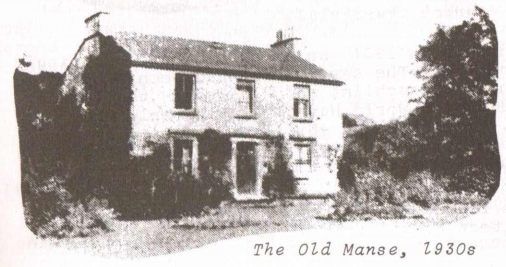
As we turn from Old Castle Road into Manse Brae on our left stands the former Manse of Cathcart, dating from 1818 but long before that the parish minister's house was on this ground. Nowadays we refer to it as "Macindoes".
When the Rev Dr Smith came to the country village of Cathcart in 1828, the nearest building in the direction of the city was Florida House or Mount Floridan, now Eildon Villas, and believed to have been occupied by a family from Florida in the U.S.A. The railway embankment spoiled the once beautiful view obtained from the Manse windows. In front the garden extended to the
rough road by the riverside called "Fordneuk Road" where a footbridge, now Delvin Road Bridge, led over the Cart into Fordneuk "Park". The road was constructed in 1894 to make one of the entrances to the new railway station.
After Dr Smith's death, the assistant minister for the past 14 years, Rev Gavin Scott Wotherspoon, was ordained but lived only a year. He was succeeded by Rev M. Claxton M.A. who in 1905 moved into the new Manse, Carmunnock Road, and the Macindoes moved into the old one. Of families with roots firmly planted in Cathcart soil, the Macindoes are among the best known.
On the site of the Old Men's Club was a small steading called "Kilmailing", built in 1875 for Mr John Macindoe. He was a farmer and contractor his horses chiefly employed in carting for R & J Couper and G & J Weir. Now horses have given way to petrol, but the business is still carried on as a garage and service-station by his grandson, Hugh Cullen who, as a kirk elder continues the link with the old manse and the parish church. The wall which backed the stables can still be seen, looking older than the manse itself, but of the village school there is no Sign.
In his famous Book of Discipline (1561), John Knox planned a school in every parish which became compulsory by 1646. He also planned to provide all grades of education - from primary to university, for everyone able to profit from this, whether the children of rich or poor. His ideals failed to materialise through lack of money for many years.
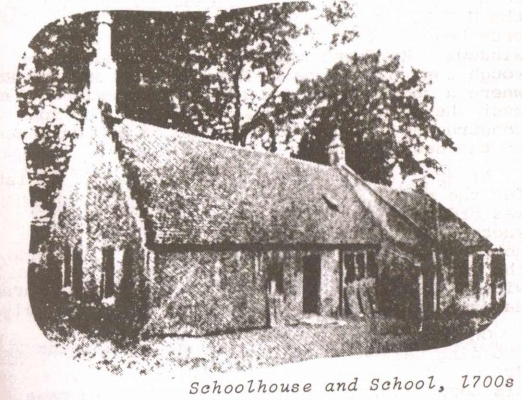 In Cathcart the first school we know of was in the 18th Century. The School House and School Room, built in 1719 and 1798, stood at the top of Manse Brae. The gable of the house was to road where Crawford's once stabled horses, and now a garage. Presumably the dominie's house was also the classroom until the number of pupils necessitated a school room. Mr William Dempster was the schoolmaster for 30 years or more, his house being occupied afterwards by the church officer who also acted as the local grave digger.
There are hazy memories of the old house on Crawford's site, with the level of the road so raised as to be almost alongside the window-sills; also a lovely tree which stood sentinel at the cross-roads outside the old manse gate. Being a traffic hazard it had to be removed, an event which was recorded and photographed by the local press (so far with negative results) .
The volume of traffic has so intensified over Manse Brae in recent years that it seems unbelievable to have been able to walk back and forth to Church or Sunday School in the middle of the road with no thought of passinq cars.
There is also the memory of a school friend's grandparent paying the dominie fourpence in fees to attend the school in Manse Brae.
About 1830 this new school and adjoining house were built opposite the old ones where the tenements of Atholl and Knowe Terrace stand. The Ladies Society of Cathcart, formed mainly for clothing the children of the poor, instituted a girls' school modelled on the schools of industry. It was held in the parish classroom. A salary was given to teachers appointed by them to
instruct a limited number of girls recommended by this society while teachers received fees from parents who voluntarily placed their children under the teacher's tuition.
From the Statistical Account of 1842 we learn that the schoolmaster's salary was approximately £31 per annum. To augment this, the parish schoolmaster often took on the job of Session Clerk.
In 1846, Dominie Andrew Carnduff whose name is now legendary Carnduff's School) came from Eaglesham and taught until 1876 when the parochial system came to an end. Several families will tell you that "Grandpa" was one of Carnduff's boys - but strangely enough no-one mentions Carnduff's girls !
Thomas Campbell, Glasgow poet genius of his day (he merits a statue in George Square), frequently visited the school as a boy and, returning after a lapse of years to experience the disappointment changes in time had wrought, even at the beginning of last century, wrote "Lines on revisiting Cathcart. He also penned his "Epistle to Three Ladies" ..... " the sister Friends that dwell on Cartha's side". Campbell was not the only poet who wrote of Cartha's lovely vale, evidently Burns, Tannahill and Grahame also sang its praises.
LINES ON REVISITING CATHCART
by Thomas Campbell 1777 - 1844
0, scenes of my childhood and dear to my heart,
The green waving woods on the margin of Cart
How oft in the morning of life I have strayed
By the stream of the vale and the grass covered
glade
Then, then every rapture was young and sincere
Ere the sunshine Of life had been dimmed by a tear
And a sweeter delight every soene seemed to land
That the mansion of peace was the home of a friend,
Now the scenes of my childhood and dear to my heart
All pensive I visit and sigh to depart
Their flowers seem to languish - their beauty to
cease
For a stranger inhabits the mansion of peace
But hushed be the sigh, that untimely complains
While Friendship with all its enchantment remains
While it blooms like the flower of a winterless
clime
Untainted by chance, unabated by time.
On March 2nd, 1876, Cathcart School Board opened Craig Road School, the average attendance being 178. In September, 1913, the authorities used the ground flat of the school house specially for subnormal children. The old school was demolished in 1967 and the new St Oswald s School opened on November 11th, 1966, is devoted solely to the teaching of pupils in this category.
As population increased, Holmlea School was opened on September 4th, 1908, by the Chairman of the Cathcart School Board, Mr William Watson. Mr Angus Campbell B.A., F.E.I.S., was appointed Headmaster and about 500 pupils enrolled. The Parish School Board ceased to exist after 1920. With numbers exceeding 1000, in the late 1950s the Couper Institute was brought into use but the opening of schools at Merrylee and Simshill eased the situation.
Teachers, like policemen, seem to look younger than ever before, yet Miss McColl and Miss Breingan passed so many generations through their hands -
the latter obtaining for the Primary Department the school badge of the Castle.
In 1965 closed-circuit-television for schools was introduced - pioneered by Glasgow, let us not forget - and several parents were delighted to be invited by Mr Murray, the headmaster, to view a playlet in French by six of Holmlea's
pupils .(Evelyn Marshall, to whom this book is dedicated, being one of them). Her primary school memories will include Miss Hamilton and Mr Murray, not forgetting the school "janny" (janitor), the amiable Mr Greenock.
Former pupils may like to recall their own particular headmaster:
1908-1923 Angus Campbell B.A., F.E.I.S.
1923-1927 William Dawson
1927-1932 John C. Brown
1932-1936 Hugh Duncan M.A.
1936-1943 J. Selfridge M.A., B.Sc.
1943-1946 Jas.H. White M.A.
1946-1946 Jas. Addison M.A.
1946-1948 Robert Carse M.A.
1948-1951 John Anderson M.A.
1951-1961 M. Morrison M.A.
1961-???? Robt. J. Murray M.A., B.Sc.
Ch 6. The Bridges
No other place in Cathcart has attracted the artist and the photographer more than this bridge. Only ten feet wide, it bears the date 1624 [see Note 1], but according to experts the datestone has been inserted from an earlier bridge! This opinion, although not widely accepted, is a view shared by a few local residents.
There is the legend of Francis Murdoch [see Note 2] Dean of Guild of Ayr, who was drowned in 1722 while attempting to ford on horseback the
River Cart, then in spate. If the bridge was there, why cross a swollen river by other means? Being purely conjectural the original bridge may have fallen into disrepair and so the present one may have been built around this period or slightly later [see Note 3].....
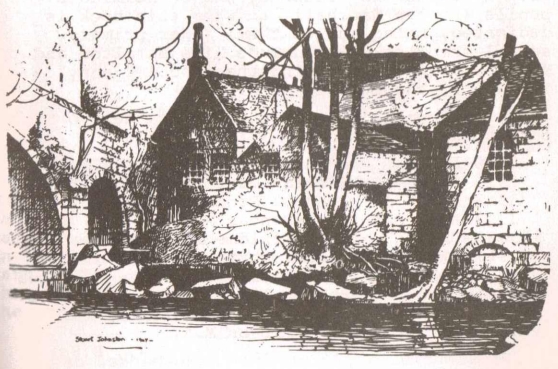 We do know that the bridge was a most important crossing of the Cart, being a link on the sole highway from Glasgow to Ayrshire. Many a distinguished traveller passed over it, including Robert Burns in his quest for a publisher of his poems; Robert Pollok on his way to college from his farm on the Mearns moors; Thomas Tannahill and John Howie of Lochgoin, author of "Scots Worthies".
The bridge is not unlike the famous Brig o'Doon, and at one time there were vestiges of the Caledonian Forest above the high banks of the river. Before the removal of the mill water-wheels and before the traffic barriers were erected in 1924, the scene was one of great natural beauty. It still is, but for the 20th Century innovations: The datestone is placed near the eastern end of the north wall, about a foot below the top.
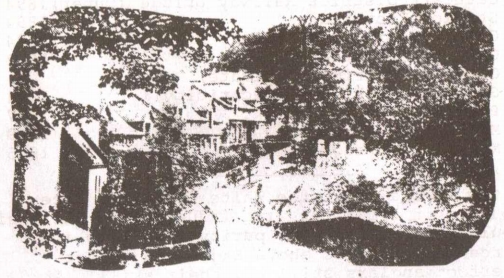 Apparently three fords crossed the river, one alongside the Old Bridge, the second where Delvin Road Bridge is erected and the third near the present granite bridge joining Holmlea and Clarkston Roads - known as Cathcart Bridge. It was built to take the tramway lines, and was opened on August 7th, 1902.
Previously, a picturesque hump-backed or arched structure spanned the river, dating from 1800. Mr McNeil's house "Bridgend" still stands but his joiner's shop is no more. As the river is known to rise very quickly to some depth here, it may have been at this ford the unfortunate gentleman from Ayr was carried away.
As an observation test, how many bridges have we over the River Cart? In the area of the former Burgh of Pollokshaws, the claim is made that the number of bridges over the Cart and Auldhouse Burn is a record. Cathcart extends over a large area, however, and in its course through the district we can boast quite an impressive variety:
Linn Park Main Drive Bridge (The Ha'penny Bridge?)
Snuff Mill Bridge 1624
Delvin Road Bridge ?
Lanarkshire/Ayrshire Railway Bridge 1903
Cathcart District Railway Bridge (Outer)1894
Station Footbridge 1894
Cathcart District Railway Bridge (Inner)1894
Cathcart (Holmlea)Bridge 1902
G & J Weir Bridge (Private) ?
South of Scotland (Electricity) 1914
Public Footbridge 1957
Millbrae Bridge 1899
McQuiston Bridge 1905
"Now a word about the White Cart. It once abounded in trout but with industry and increasing population has lost its purity. Towards its source in the hills above Eaglesham and at Waterfoot anglers still try their skill. At Cathcart Castle the river flows north-west to Paisley and meets the Black Cart at Inchinnan. In the 18th Century nearer Paisley the White Cart produced pearls of such considerable size that they attracted the attention of some of the most famous jewellers in Europe."
(History of Renfrewshire, 1710)
Thomas Campbell the poet refers to the beautiful and tranquil scenes .... "by Cartha's side".
Footnotes
- Dr Gomme and David Walker in "Architecture of Glasgow". 1l968. who date the bridge as late 18th Century
- Hugh McDonald's "Rambles Around Glasgow" took him to the old kirkyard where he browsed among the tombstones and found the following inscription: "Here lies the corpse of Francis Murdoah. Dean of Guild of Ayr.
who died March 17th, 1722" - The date of the present bridge is substantiated by James Grahame's lines
written somewhere between 1765 & 1811:
"Forth from my low roofed home I
wandered blithe
Down to thy side sweet Cart.
where cross the stream
A range of stones below a shallow ford
stood in the place of the now spanning
arch."
Ch 7. The Mills
Solomon Lindsay, born in 1722, came to Cathcart from Penicuik in 1812 and began the manufacture of paper in what had been a meal mill at the side of the Old Bridge. Two years later he introduced a new feature, the manufacture of snuff which occupied only a small part of the building.
Glasgow was past the throes of the tobacco trade with America when manufacturers sent their leaf to Lindsay's to be ground into snuff. Cardboard used in bookbinding, however, was chiefly produced here at the mill.
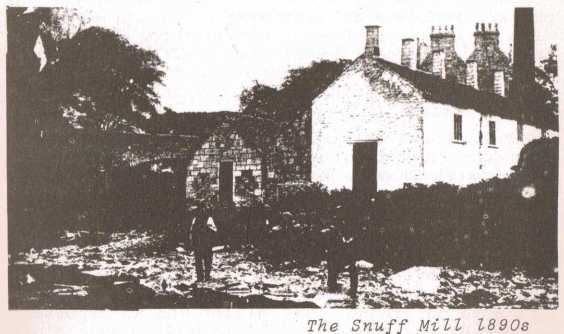 After his death in 1859, his son David Lindsay carried on the business until 1902 when he died in the same room in which he had been born 85 years previously [see Note 1]. His cottage was where Mill House now stands at the entrance to the Linn Park. At one time he thought of marriage and was given permission by the Earl of Cathcart to build a house for his bride-to-be. Lindsay House was erected in 1863.
His lordship, however, was extremely annoyed at the large house in old baronial style instead of the cottage he had expected. David Lindsay never did wed, and soon flitted back to his "ain wee hoose". Above the door of the former main entrance to Lindsay House can be seen a perfect monogram, all the letters of the name "Lindsay" being entwined. It later became one of the
tenements the old gentleman also very possibly deplored. (It may never have occurred to him that he too altered the landscape in building this house, in design so different from the rest).
With the owner's death, the mill closed and the stock was sold, bringing to an end Cathcart Paper Mill, known in the trade as "No 19". Three years later the Earl sold the cottage and mills to the later Mr McIntosh who took down the cottage and built on its site the villa "Mill House". Since the recent death of Miss McIntosh, the last member of this family, the name of the house has been removed.
The ancient mill is in use temporarily as private lock-ups at the moment. Though at one time three water-wheels existed, none is now to be seen. The part of the old snuff mill which stands at the river's edge bears the date 1858 but that part adjoining the road is the really ancient section.
When stocks were cleared, souvenir containers of snuff were distributed among local residents. There is at least one left after all these years.
CATHCART MILL
As is well known, every district long ago had its meal mill to which the farmers sent their A grain to be ground. The miller was an important member of the community and usually a man of substance. Two stones lying side by side in the old churchyard mark the graves of generations of Halls who were the millers of Cathcart. For record purposes only, on one stone is the following:
"Here lyes the dust of John Hall of Cathcart
Mill, and of Ellison Craig, his wife, AD 1689;
likewise of John Hall in Cathcart Mill aged 80
who died AD 1743; and of Helen Gilmour, his
wife 1773".
On the other stone:
"Here lies
interred the body of James Hall of Cathcart Mill
who departed this life December 14, 1782, in the
57th year of his age and is the burial place
appointed for his wife and their children".
However, no further names have been added (See next chapter) .
LANGSIDE MEAL MILL
The mill was erected before the end of the 16th Century at the foot of Millbrae, at the west corner of the road at what is now Tantallon Road. A small cottage still stands a short distance from the foot of the brae looking down on Millbrae Bridge. This was the miller's house and the mill occupied the ground in front of it.
Millbrae derived its name from this, in all probability. The inlet of the lade was upriver at the bend near Carmichael Place, and the outlet a short distance below the b.ridge. There used also to be a high wooden fence from the Bluebell Wood to Millbrae Road" so close to the river that it only left a narrow lane instead of today's broad Tantallon Road. The millers here were the Uries and afterwards the Craigs. The mill was destroyed by fire in 1852, now only the cottage remains. Perhaps some day there will be some interesting excavations here?
[?? Modern Map reqd]
Ch 8. Millholm
About 1660 paper was first manufactured in Scotland and towards the end of 1685 a French refugee driven from his country by religious intolerance arrived at Greenock with his daughter Elise, then about six or seven years old. Friends there encouraged him to further his business of paper-making in the West of Scotland and so he made his way to Glasgow.
Nicholas Deschamp collected rags and in time set up the paper mill by the side of the River Cart, known afterwards as Paper Mill Farm (at the end of Earlspark Avenue, beside Langside Station). He called on the "guidwives" of farmers and cottars, and astonished them by saying in his broken English that, however soiled and worthless the rags were, he would "buy dem all and make dem ver good for lily vite paper". Business continued to prosper and in 1729 or soon after, he moved to larger premises at Millholm on the south side of the river not far from Cathcart Castle.
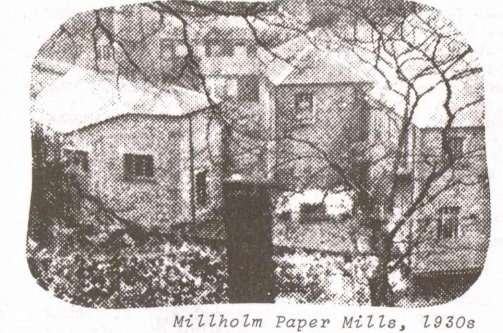
Each of the paper mills, it will be noticed, was situated beside a weir since a plentiful supply of pure water was necessary for good writing paper or cardboard. Millholm was certainly an ideal spot. The buildings were almost hidden from view by the trees with only the chimney stack visible (demolished March 18th, 1938). The spoil was used for the Empire Exhibition at Bellahouston.
Elise Deschamp married the meal miller's son James Hall who was apprenticed to her father and who afterwards inherited the business. He died in 1759 and, so far as we know, the paper mill continued in the family until the beginning of the 19th Century. Generations of Halls are buried in the old churchyard and confusion reigns between the Halls who were millers and those who were paper-makers. It is suggested that the old Frenchman changed his name to Hall but there is nothing to prove or disprove this. No doubt he lies in the parish churchyard.
 According to church records, only by publicly appearing before the congregation and renouncing both the pope and the Devil was he accepted as a member of the Church of Scotland. During his sojourn in Cathcart he had been a regular church-goer and enjoyed a certain measure of respect as a businessman, yet, with true Scots canniness, the people were also suspicious of him. In 1696 he subscribed £100 to the Darien Scheme and supplied the paper used by the Darien Company. At that time he made no effort to change his name. Elise Deschamp, after her marriage, was known by the diminutive· "Peggy" .
Millholm, it is believed, was in the hands of Hall's trustees until sold to Messrs R & J Couper in 1853 who had been tenants since 1841. During these years paper had been made by hand but in 1853 the Couper Brothers introduced machinery. Known as Mill No.18, the Couper Mills manufactured paper for writing purposes used by banks and lawyers. Large orders were also placed by the Government.
Robert Couper was joined in the ventures by his brother James, a local carpenter. They were men of principle and held in high esteem. About £8,000 was left by Mr Robert Couper to build a hall, reading room and library for Cathcart. He also left a sum of money called the "Couper Bequest" for the benefit of local people in dire need, the only condition being that they reside within a mile of Cathcart. Miss Marion Couper, the last of the family, died in 1933 aged 84. It was she who launched a scheme.to start the Victoria Infirmary as she was disturbed at the lack of hospital facilities on the south side of the Clyde. The "Victoria" was eventually opened in 1890 by His Grace the Duke of Argyll and dedicated by the Rt Rev James Smith, D.D., of Cathcart Parish Church. Yes, Cathcart has had good reason to be grateful to the Couper family.
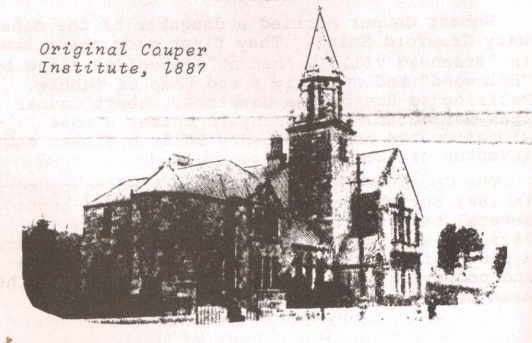 At the time of the annexation to Glasgow in 1912, the Corporation decided to make alterations to the Couper Institute to meet the reqUirements of an increasing population, but owing to World War I this was not completed until 1923. The Lord Provost, Sir Thomas Paxton, Bt., L.L.D., opened the halls on April 18th. The Chairman and Convener of the Halls Committee, Councillor George D. Morton, announced that the original estimate for the work had been approximately £20,000 but now, after the war, it was in the region of £40,000 - so even then costs were escalating to a surprising-degree.
The original Couper Institute remains with the name and date 1887 inscribed in front. The architect was James Sellars, who also designed the Victoria Infirmary. The Library, a most excellent one, was built on the one side and the large hall on the other.
James Couper lived in "Holmwood", close to the mill. This house is a splendid example of "Greek"Thomson architecture and was built in 1859. Several well-known business gentlemen have been the owners, one of them being Bailie James Gray, J.P., who Closely resembled the late Lloyd George. When the Liberal leader visited him in the 1920s, Cathcart was en fete for the occasion.
Since 1959, "Holmwood" has been the convent of "Our Lady of the Missions".
Robert Couper married a daughter of the manse, Mary Crawford Smith. They first made their home in "Braehead Villa", then at"Sunnyside" close by "Holmwood" and now only a sad heap of rubble. Retiring to Rhu on the Gareloch, Robert Couper lies buried in the churchyard there, almost alongside the grave of Henry Bell, engineer and inventor of "Comet" fame.
The Couper Mills were sold as a going concern in 1884 but throughout the years changed hands several times. The older mill closed down in 1929 and was demolished in 1938 while the other, a flock mill, was bought by Macfarlanes in 1947 and converted to a civil engineering plant. The main building was gutted by fire in 1953.
Ch 9. Burial Places
In the autumn of 1904, before the houses along Earlspark Avenue were built, workmen digging there unearthed relics assigned to the Bronze Age. In all, four urns, bone deposits, charcoal and four pits were discovered and described in a paper by the late Ludovic Mann, F.S.A.(Scot.) as a burial ground with urns, but he was not of the opinion that cremation took place at this spot. One of the funerary urns was said to be the largest recorded from Scotland, and all are now housed in the National Museum of Antiquities in Edinburgh.
Another relic of pre-historic times came to light a few years later in the Bluebell Woods (Tantallon Road) in the form of a boulder with cup-and-ring markings similar to symbols found on the Cleuch Stone at Cathcart Castle Golf Course in 1930. Their true function is unknown but one theory is that each was possibly a place of sacrifice in sun-worshipping days.
Cathcart cannot claim any Roman remains but there is a wealth of history within the walls of the old churchyard. In an age when religion is regarded lightly by so many, it must be difficult for the young to realise that here in this parish (as well as elsewhere in Scotland) men died for their faith. The Covenanters would not submit to a form of church government they could not on conscience accept, and in the 17th Century tolerance was unknown.
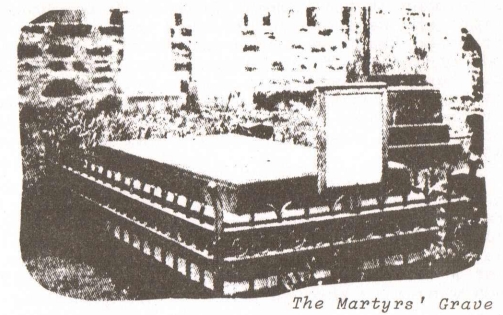 The lands of Polmadie were within this parish which explains why in the churchyard there is the grave - the "Martyrs Tomb" - of two weavers and a farm labourer (Robert Thorn, Thomas Cook and John Urie, "three UNcommon men of Polmadie") who died for their beliefs on May 11th, 1685. A short service is held annually at the graveside. Urie was also a Cathcart family name and John Urie may well have been a local which again could explain why all were laid to rest here.
The cemetery used to be unobtrusively sectioned off, one part being reserved for the elite of the district. Here were the family vaults of the Hamiltons, the Gordons of Aikenhead, the Coupers, and graves of the Lindsays and Halls, etc. Today time has erased the class barrier.
The "doleful literature of the dead", as Hugh McDonald described it, is now barely decipherable but on some of the headstones one can still read of those once-flourishing trades - snuff miller, paper maker, smith and so on. Names of unheard of farms and an area called "Maggieshill" are lost in the mists of time.
Alongside the old church hall there is a stone designed by Alexander "Greek" Thomson, a promise he honoured to his master builder, John McIntyre.
The village dominies, William Dempster and Andrew Carnduff, have their special place in the annals of Cathcart, and beside them sleeps the "Adam Blair" of a powerful tale written early last century. He was a minister of this parish many years before that, deposed for misconduct and reinstated at the earnest desire of the whole parish who were deeply attached to him. James Gibson Lockhart, son of a Lanarkshire minister and son-in-law of Sir Walter Scott, wrote this book based on facts he had been told by his father. Tpe book shocked the public; nevertheless, even for those times, the author was paid 1000 guineas for.his next novel, which was twice the sum for "Adam Blair".
The writings on one of the tombstones revealed to Hugh McDonald the story of the unfortunate Francis Murdoch, drowned when fording the Cart, and no doubt "Frenchie" (Nicholas Deschamp), Glasgow's first ragman, is interred here also. What a cross section of village life is unfolded when wandering through the auld kirkyard.....
The bad old days are recalled with the Mortsafe or Watch-house, a small stone building about ten feet square, erected nearly 150 years ago to prevent bodies being stolen from the graves. Spare-part surgery is today a topical subject with the medical profession and others, endeavouring to reach agreement as to whether or not healthy organs should be removed from the dead. It was also for the purpose of surgery that the shocking but lucrative practice of "body-snatching" occurred all over the country. Burke and Hare were the two most notorious characters who murdered people in order to sell corpses for dissection.
Various methods were tried in order to stop these shameful thefts, hence the mortsafe. After a funeral the mourners took it in turn at nights to guard the grave with a GUN: In their recent exhibition of relics, the Parish Church of Carmunnock had one of these guns on show. Another deterrent was a strong barred "cage" where the coffin lay for weeks before decent burial, in order that partial decay set in and the body would be safe. With the passing of the Anatomy Act in 1832 the body-snatchers' trade was rendered unremunerative and brought to an end these acts of desecration.
The "Hacketthorns" or "Halket Thorn Brae" used to be in Netherlee Road but the thorn trees were all removed when Cathcart Cemetery was formed in 1876. The brae was supposed to be named after a Captain Halket, killed by a cannon ball fired from the precincts of Cathcart Castle at the Battle of Langside. (One of these cannon balls is in Dr James Macfarlane's possession)
Cathcart Cemetery was apparently something new in the history of Glasgow sepulchres. Usually associated with desolation and gloom, a small handbook issued at the time pointed out a "cemetery in the country, accessible from the city, laid out in artistic taste, was hardly dreamed of, yet all was combined in Cathcart".....
Strangely enough, this could also apply to the Linn Crematorium opened in 1962, and so the chapter ends as it began. In our ignorance some of us regarded cremation as new to the western world ..... but enough of cemeteries.
Ch 10. Court Knowe
Fornenst the Castle there is still something left of romantic Cathcart. In Court Knowe one may quietly stroll or sit and muse over past events when knights went forth and the ill-fated Queen perhaps stood on this very spot to view the Battle of Langside.
When the hawthorn bush known as "Queen Mary's Thorn" withered away about 1799, General Sir George Cathcart erected the first monument - a rough block of Giffnock freestone - on which he himself carved a crown, the letters M.R. and the year 1568. This is now on view in the People's Palace, Glasgow Green. The present monument was gifted by Lord Cathcart, the General's nephew.
As mentioned earlier, the road from Delvin Road to the Castle was originally the "Rhannan" and the spring which used to flow by the roadside (before the villas were built, and at No 157 approx.) was called the Rhannan Well and sometimes Queen Mary's Well, as this lady was supposed to have sipped of the waters here.
The road was considerably widened when the villas were built by Mr Dick, but previously it was about 22 feet wide, bordered by hawthorn hedges and underfoot extremely rough-going. Solid rock protruded, particularly in front of the Castle, and not at all suitable in our time for high heels or pram pushing. However it was a pleasant Sunday walkway.
Sir Walter Scott in "The Abbot", one of his famous Waverley Novels, placed the Queen as viewing the Battle of Langside from Crookston Castle but all are agreed this was in error since no part of Langside could be seen from there.
The quater-centenary of Langside (recognised by an exhibition at Camphill Museum for which credit must go to the boys and staff of Hutcheson's Grammar School) caused both young and old to wonder what led to this affray.
Langside could be regarded as a battle mainly betweent the old order and the new in religious matters, with side issues to complicate the whole grim business.
The Regent Moray, half brother of the Queen, had received information that she intended marching from Hamilton to the security of Dumbarton Castle by way of Langside, Crookston and Paisley on May 13th, 1568. Had not Argyll, who was in command of Mary's forces, taken ill suddenly earlier that day, the results might have been different although it has been hinted that this illness was feigned since Argyll was related to the Regent, yet another instance of the treachery and intrigue surrounding a Queen who lived before her time.
Mary's army, composed mainly of Hamiltons and numbering thousands, took up position on Clincart Hill (Langside College) to face the Regent's much smaller army on Langside Hill. The Regent was fortunate in having skilled men at his side, one, the celebrated Kircaldy of Grange, the finest Scottish soldier of his time. He led the attack down the narrow main street of Langside. The Hamilton men fought valiantly; not so Argyll's men who, leaderless and undisciplined, took to their heels. The battle did not last one hour and was over by 10 a.m.
The Queen, viewing the scene (from Court Knowe?), mounted her horse and rode into battle in an effort to encourage and rally her troops but the situation was hopeless. All chances of regaining power now forever dashed, she fled to England to her cousin Queen Elizabeth where further imprisonment and eventually execution awaited her.
Sir William Semple on whose lands the battle was fought resided in Cathcart Castle at the time. His wife was a daughter of the aforesaid Kircaldy of Grange and Sir William with his tenants fought on the right wing of the Regent's forces as also did Lord Cathcart.
Court Knowe, numerous streets, Queen's Park and the monument on Langside Hill commemorate this eventful day. In such a busy thoroughfare as Battlefield where undivided attention must be given to the traffic, who now stops to read the inscription on the library wall or pauses to reflect that on this ground happened one of the turning pOints in our national history?
There is an old tradition that the slain, being papists, were not allowed to be buried in the parish churchyard but were interred in marsh ground at Camphill, known afterwards as the "Devil's Kirkyard". On the south side of Camphill Church remains of bodies and weapons of war were found when the pond nearby was constructed.
Whether Mary, Queen of Scots, ever stood on Court Knowe or whether it took its name from the place where justice was administered in feudal times (in the Castle courtyard or "court"), we should be grateful to the two gallant gentlemen who were determined its historic significance should not be forgotten.
MALL'S MYRE
Malsmire, spelled in so many different ways, is remembered as the place where the Queen's horse stumbled when she fled southwards after the Battle. Today the only reminder is a public house of that name in Polmadie Road, other than a small waterway known locally as Jenny's Burn. Mall's Mire was on the estate of Castlemilk - and Menock Road was formerly Malsmire Road (and Pit Road) as it led to the Crookston Coal Pit. A toll house stood at the corner of Carmunnock Road and Menock Road.
Polmadie in early 12th Century was Polmade, in 1318 was Polmade and in 1654 Polmadie. The name is said to mean "pool or burn in the field of God" (or according to Jack House in his "Heart of Glasgow", as "pool of the wolves"). So any explanation regarding this name being derived from the royal incident of the Queen and her horse is obviously incorrect).
THE HUNDRED ACRE HILL AND DYKE
Before it passes into oblivion a word or two about this well-known landmark of yesteryear. The "Hill" is more or less completely covered by residential King's Park and King's Dyke, King's Acre and Curtis Avenues are all that remind us of a folly.
The story goes that the laird on whose ground the "Hill" was situated enjoyed many a convivial meeting with his contemporaries. In the early 19th Century to be a "gentleman" it was qUite in order to get drunk at least once each day. During one of these "sessions" discussion arose as to how much ground would be covered by one hundred acres. The laird was easily talked into building a wall to enclose this area - and he did just that! Work began in 1806 and cost the laird £30,000 which ruined him completely. There seems to be a moral in this story somewhere!
Meikle-Aikenhead or Baird's Farm on top of the Hundred Acre Hill was also a well-known landmark for years, but it too has disappeared along with four dilapidated little houses given the name of the "Eternity'Cottages". Before they were built the laird's factor had been negotiating with him for some time over this piece of ground. All seemed to be going quite well and the factor duly returned home. Suddenly he rushed back to the landlord's house, he having by this time retired for the night, and on rousing him the factor said It's me, laird! Aboot that lease, the contract has been drawn oot for nine hundred and ninety-nine years, and when the lease fa's oot, I waant the first chance o' the renewal!"
(from Gartshore's "Cathcart Memories")
Ch 11. The Pillar
The principal pillar decorated with the arms of the Cathcart Family and built entirely at their expense can be seen in Paisley Abbey. There is also the Cathcart Aisle and the resting place of the first Earl, William Schaw Cathcart, inscribed with the family motto "I hope to speed".
It will be remembered that it was the custom to make generous gifts to the church and this family was renowned for its religious zeal. They appear to have been over-generous since it was at this time (1546) that the Castle 'had to be sold to the Lords of Sempill.
Tradition has it that long after the incident, this pillar commemorated the safe return of Sir Alan Cathcart from the battlefield in Spain where he and other Scottish knights led by Sir James Douglas carrying the heart of Bruce to the Holy Land found themselves in the thick of battle against the Moors. Sir James flung the casket containing the heart before him into the affray, crying, "Lead on, brave heart, as thou wast ever wont to do. Douglas will follow thee", and in so doing the gallant Sir James Douglas was slain. The casket was later'retrieved and brought back by Sir Alan and others and laid in Melrose Abbey.
Cathcart Old Parish Church ever reminds us of its early connection with Paisley Abbey, as stated on its notice-board, viz., "attached to Paisley Abbey 1160-1560, Disjoined from Presbytery of Paisley 1596".
FOOTNOTE
"The Heraldic Arms of Scotland" describes the Cathcart Arms as-Azure, 3cross crosslets fitche issuant from as many crescents argent.
Ch 12. The Smiddy
On the Old Castle Road the village smithy stands, although the walls seem ready to collapse. Adjoining this ancient building and reached by an outside stair was the Dog Infirmary. Mr Robert Peddie was at one time the vet, and blacksmith, and his thatched cottage stood alongside until 1892 when a tenement "Rosebank Terrace" was built on the site.
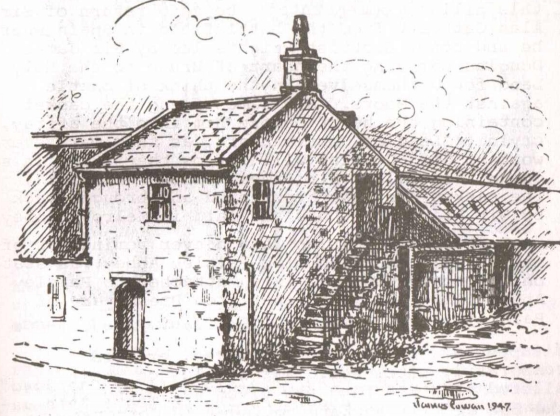 "Rosebank Cottage", on the opposite side of the road until recently, belonged to this family of vets and smiths. Miss Roberta Peddie (Mrs J.S. Tait) is the last representative of a family who have lived in Cathcart for hundreds of years. Originally armourers and smiths to the Cathcart Family, one, branch through time became known as the 'Farmers' Peddie and the other as the 'Smiths'. When Carmunnock Road and Manse Brae were but winding country roads, Cathcart Mains Farms was beside the old manse. Castle Mains Farm was also known as "Peddie's" although Mr Robert Ure had taken over the farm for forty years. He died in 1958 and privately-owned houses, now cover the area.
It is said that Robert Burns had his horse's shoe repaired at the smithy. The vet. remembered by most today would be Mr A.S. MCQueen, M.R.C.V.S., who lived nearby and who died in 1938. The Dog Infirmary building has since been used by a series of small firms in no way connected with dogs.
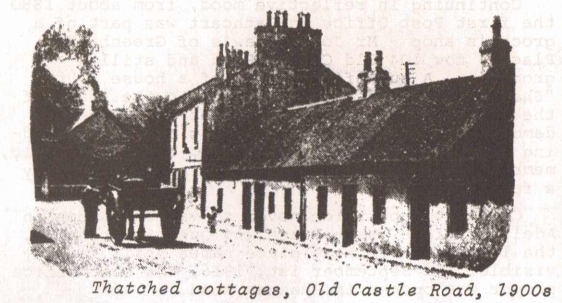 Across the way was once a "wee bit biggin'", later to become the Cathcart Rifle Range. The village well stood at this point but all have disappeared. Prefabricated homes, erected temporarily after World War II, lasted their allotted time and have now given way along with the row of mill workers cottages to Corporation-built dwellings.
Changes have also taken place along Rhannan Road. HOlmhead House once belonged to the Hamiltons. Dominie Carnduff had Cliff House built 'on one corner of Craig Road, Wilson's shop being on the other. Gone now is the row of cottages at the top of the hill.
In 1932 Edith Cottage was opened by Mrs Fred. Shoe smith and named after her. It is the happy haunt of Cathcart's old men but, with attitudes to age forever changing, the occupants today surprise us with their freshness and vigour. It is a far cry from the bearded and bent figures who at one time would have frequented here.
Ex-councillor Shoesmith was also the river bailie and chairman of the Fairy Dye Company. He lived in nearby "Hawthorn Lodge" and, through his generosity, the Old Men's Club pavilion was built. Previously on this ground was John Macindoe's steadinq "Kilmailing", and prior to 1875 there stood a row of weavers' thatch-roofed cottages.
Continuing in reflective mood, from about 1880 the first Post Office in Cathcart was part of a grocer's shop - Mr John MCGaw's of Greenbank Place - now 104 Old Castle Road and still a grocer's. A sub-office, part of a house in the "Shank" (so named because it led to the shaft of the old coal pit in Dairsy Street) was recently demolished. So too was Prosser's old shop building which was over 100 years old, though, happily, members of this family continue in business only a few yards away.
Cathcart sub-office moved to various shops in Adelaide Place, Mary Place, and Queen's Crescent, the lettering of these place names still faintly visible. On September 1st, 19l6,the Post Office proper was opened in Rhannan Road.
Today the postie's unfamiliar grey uniform replaces the friendly navy and red. Rather than wait on the postman calling, firm's messengers used to stand at given pOints to collect the mail. A charge was made for deliveries at one time - and again we hope this form of tax is forgotten for all time.
Ch 13. Before we voted DRY
"For every loaf, 12/6d" was how Willie McCulloch in one of his readings of long ago described a Cathcart grocery bill! Just how long ago can be judged from the price of the Glenlivet and also from the fact that this entertainer's records are now prized by the collector.
Towards the end of last century Cathcart had five public houses and four grocers' licenses. By 1920 there were still four pubs but only one licensed grocer. It was in this year that Cathcart went "dry" with the Local Veto Act of 1913. Since then polls have been taken in 1923, 1926 and 1965 but have resulted in no change.
The village stage or mail-coach inn stood quite near the Old Bridge - at Nos. 9 and 11 Snuff Mill Road to be precise. It was a two-storey white-washed thatched house with a garden where strawberries and cream were served as well as the usual refreshments. AlongSide was a row of thatched cottages, demolished in 1893 by Mr Robert Dick, the builder of the present villas.
This 300-year-old "howff", known as the "Wee Thack Hoose in the Glen" and later as "Granny Robertson's" for many years, was taken down and the license transferred to "Ye Old Hoose" at the corner of Crompton Avenue and Old Castle Road where on the entrance floor this name is still faintly discernible.
Thirsty folk may like to hear of the "Cathcart Arms" and the "Black Bull", both within a stone's throw of each other in Clarkston Road opposite Merrylee Road. Gow's public house was at 200 Clarkston Road. John McGaw's Post Office and grocery shop was licensed but in 1893 the "Southern Press" had this to say: "An interesting event took place in Cathcart when Mr McGaw's premises were purified by his whole stock of intoxicating liquor being carted away! Mr McGaw had seen the Light!"
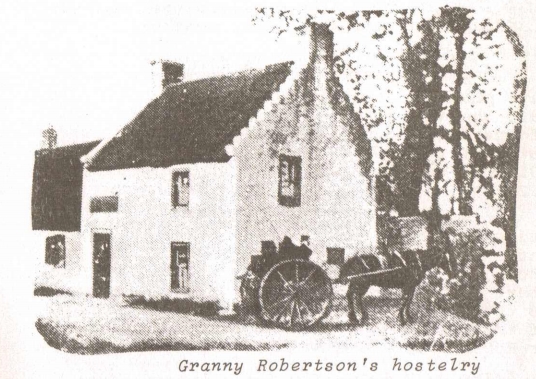 The second grocer lost his licence when found under the influence in his shop, and another failed to get a renewal through some infringement leaving one shop with a licence (Petrie's or Simpson's in Delvin Road) until 1920. In that same newspaper of 1893 some interesting sidelights are thrown on Cathcart which must have been qUite a place! We read that the Cathcart Burns Club held their annual supper in the "Wee Thack Hoose" for the last time as the property had been condemned by the County Council. The Cathcart Curling Club with its pond in Mount Florida, and news items of the Cathcart Orchestra, Cricket, Cycling and Tennis Clubs, all told of a community working hard and playing hard.
The closing years of the century appear to have been outstanding for long dry summers and severe winters. Bonspiels were held at Castlemilk House pond - the last laird of Castlemilk, Captain Stirling Stuart, presiding with the Cathcart team led by Mr Henry E. Gordon of Aikenhead.
The horse-drawn buses carrying passengers who were exposed to all the elements were entertained by "Donnelly", one of the drivers - and obviously Cathcart's answer to MCGonagall. As a regular customer at "Granny Robertson's", none mourned its passing more than he. Here is his descriptive effort, reminding us of a Cathcart far removed from Glasgow where city dwellers used to rent a cottage to pass the summer months:
GRANNY'S AULD HOOSE IN CATHCART
Cathcart is famed for beauty -
Ay, famed a' roun an' roun'
But its auld romantic buildings,
Are nearly a' pu'd doon,
Tae mak' room for improvements
That go on day by day.
The landmarks o' the village
Are wearin' fast away.
CHORUS
The auld hoose, the auld hoose
Close to the auld brig end
O mony a happy nicht's been spent
At the auld hoose in the glen.
The auld hoose for three hunner years
A licence did obtain
And granny held it forty years
Without a blot or stain
And mony a loving couple
To the glen did aft repair
For it was a treat to get a seat
In Granny's garden chair.
You could hear the blacksmith's anvil ring,
An' the auld mill grind away.
An' the River Cart flow by the door
Whaur Granny used to stay.
Behind the hoose up on the hill
Queen Mary's castle stands;
It's the maist romantic village
To be found in a' the land.
Auld Granny she has passed awa'
Unto the ~olden shore;
The auld hoose tae will soon be gone -
We'll never see them more.
o' mony a native o' the place
Will breathe a heavy sigh
When they think upon the auld hoose
An' the days that are gone by.
Donnelly. 1893
(from Gartshore's "Memories of Cathcart")'
Roads used to be little more than bridle tracks but with the passing of the Turnpike Act of 1750 a new era began. The stage coach "clattered in" and new records of speed were made and broken. When coaches travelled at 11 m.p.h. with stoppages then it was time for old folks to shake their heads at the need for such speed.
The first toll house from Glasgow to Ayr was in Netherlee Road at the gate of the Macfarlane Engineering Co. The coach road ran past the "Wee Thack Hoose", etc., over the bridge, along Craig Road past the Black Bull, Bogton Farm, Netherlee, Clarkston, Mearns and on to Fenwick. The "old" or Great Road, Clarkston to Mearnskirk, was made a turnpike in 1750 and the "new" road, Fenwick to Ayr via Eastwood Toll, constituted a turnpike in 1832.
Now,it is the age of speed and concrete, the era of fly-overs, roundabouts, underpasses - with great changes forecast for Cathcart traffic-wise, causing not just the old to shake their heads.....
Ch 14. Railway & Buses
The Cathcart District RaILway was opened from the city to Mount Florida in 1886. In May of that year the line was extended to Cathcart and the Circle was finally completed in 1894.
The station was at first on the north side of the river and this became the goods depot when the station moved to its present position. Three entrances were planned and the "entry that never was" is now a kiosk underneath the railway bridge in Clarkston Road. The old Cathcart and Fordneuk Roads disappeared in the redevelopment of this part to make way for the station's two entrances.
Running the "Cathcarts" was apparently a complicated business according to one signalman who declared it to be the best train service in Glasgow, timed to the minute. If a certain big-wig wanted to say it took a man with a good head to run a main-line station, "then it took a man wi' twa' heids tae run the Cathcarts!" This was, of course, in the early days. Later unaccountable delays at Mount Florida and probably due to the cauld blasts often felt there earned the station there the name of Mount Misery. But all that belongs to the past.
British Railways took over on January 1st, 1948, and introduced the Blue Trains.with their new design of coaches a few years ago. The circle was electrified by 1962 [see Note 1] and the name curtailed to British Rail.
Today's trains may be brighter, cleaner and faster, but the old steam engine held a certain amount of romance and character. Daily commuters had a choice between 1st or 3rd Class compartments and chose pre-arranged parts of the train to meet. Woe betide the casual who strayed into the unofficially-reserved carriage and spoiled the card game or the chatter! With little cash to spend during the week in those teenage days, full use was often made of the season tickets in the evenings. Cupid may have shot a few darts but of violence or vandalism there was none. The "Puggy" as it was less politely termed (presumably from the pug type engines) will never be the same again.
The station was built amidst green fields and pasture land. To Mount Florida Station the view was uninterrupted, and looking in an easterly direction the only building was the toll house at the corner of Carmunnock and Malsmire Roads. To the north was Cathcart Free Church, better known as Battlefield East, while beside it was Crichton's House "Aitkenlea" and on the hill above "Eildon Villas".
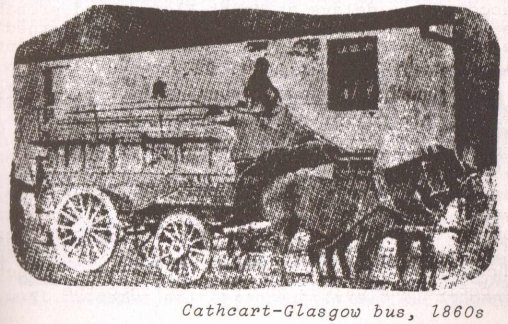 There were also villas on Langside Hill with no other buildings in between. When the River Cart overflowed its banks the flooded fields were a reminder of the meaning of the word "Holm" (as in Holmhead, Holmlea, etc) meaning level low ground on banks of a river". In the l890s serious flooding occurred at "Aitkenlea", causing heavy losses in poultry and cattle. About five years ago the River Cart overflowed to Holmlea Road by the bus depot, this same piece of ground once called "Aitkenlea".
Before the advent of the railway, Peter Craig's two buses ran for many years from Gow's public house in Clarkston Road to the city from 8 a.m. until 6 p.m. on weekdays, the last homeward journey being at 7 p.m. It was said that they I were good comfortable vehicles drawn by two well-fed horses.
The Tramway and Omnibus Company ran horse and mule drawn cars, and the laying of rails in Glasgow streets began in the 1870s. The Corporation continued with horse-drawn vehicles. until the turn of the century, but Cathcart never saw this type of tram since it got no further than Mount Florida which was then the city boundary. A depot was built and Holmlea Road constructed in 1900-01 especially for the electric trams, the first of which appeared on September 13th, 1902.
For many years trams were known by their colour and number. White No. 19 trams plied between Cathcart and Springburn termini, and yellow No.5 between Kirklee and Netherlee or Clarkston. The routes diverged at Garry Street and the fares varied from ½d to 2½d. The service was second to none, and the city's farewell in 1962 will be remembered for some time to come. All models of trams are exhibited- in the excellent Transport Museum at Pollokshields.
Motorbus services started in Glasgow in 1924, followed by trolley buses ("silent death") in 1949. The wires for the latter disfigured the roads with unsightly poles and overhead wires but were soon removed in favour of the present diesel vehicles.
The "troubles of the country" are again apparent, and the city's transport department has to cope with an acute shortage of staff as well as high running costs. Some new system of public transport is clearly required, but what .....?
Ch 15. The Parks
New highways are planned to converge on Cathcart in the 'seventies. Let us hope that these changes will not interfere with our two lovely parks, the Linn and the King's Park. Whatever the season, the tree-lined avenues and wooded paths bring pleasure and peace - or in the open spaces children have somewhere to play without the warning notices to "Keep Off The Grass".
In the Linn the waterfall provides one of the attractions; another is the Nature Trail, the first of its kind in Scotland and introduced here in 1965. It has proved extremely popular with education authorities and youth organisations within the city. Trees, one hundred-years-old and more can be studied, also shrubs, flowers and insects.
The first children's zoo was opened in 1967 with all the domestic type of animals to delight the young. An aViary is also included. Mr Arthur Oldham, the very progressive Director of Parks, is to be commended on his ambitious schemes; praise, too, to the employees of the Parks Dept.
The Linn Park was acquired by the Corporation in 1919, and was opened to the public two years later. The estate, once part of the land of Hagtonhill, belonged to Sir John Stirling Maxwell of Pollok, and to Mr Gordon or Aikenhead, while the Mansion House area was owned by the Hendersons of the shipping line. The lower part with the entrance in Greenock Avenue was opened in 1927, the Castle and policies being the property Of the Earl Cathcart.
Equally beautiful, although much smaller, is the King's Park, formerly the home of Gordon of Aikenhead, The first mansion of Aikenhead was a small thatched dwelling, and an ancient charter informs us that the lands of Aikenhead were confirmed by Robert II to John de Maxwell, Knight, and his wife Isabella de Lyndesay, the King's grand-daughter, in 1373. The Maxwells remained at Aikenhead until 1611 when the estate was sold to the Hamiltons, a branch of the ducal House of Hamilton, whose name appears frequently as the owners of estates in the 17th and 18th Centuries.
In 1808 John Gordon became the owner. The Gordons were a noted Glasgow merchant family, and it is from them that Gordon Street in the city gets its name. His grandson, Henry Erskine Gordon, was the largest heritor of this parish and also the patron. There were five daughters, several of whom regularly were seen on horseback in Cathcart before the first world war. The ladies left the neighbourhood, and nothing more in known of them; but the locals remember that the horses were handed over to Weir's "Terriers" on the outbreak of war.
The King's Park was gifted to Glasgow Corporation by Sir John A. McTaggart in 1930.
BOGTON HOUSE
This fine old mansion, over two hundred years old was situated in Clarkston Road opposite Muirend Road. Few will remember it as it was demolished in 1906, but Bogton Farm (on which a supermarket is now built) survived much longer.
The lands of Bogtoun originally belonged to the Blairs of Blair, then to Lord Cathcart who sold it back to the Blairs of that ilk. In 1663 the Hamiltons of Aikenhead became the owners, and the estate was eventually acquired by Mr Gordon.
BOGTOUN CASTLE
This was erected about 1580 but nothing now remains of it.
In this parish were three castles - Cathcart, Bogton, and Lee at Williamwood.
Ch 16. Passing Thoughts
In Glasgow's parks the entertainers once held sway, and concert parties and military or works bands visited regularly each week. Admission charges were moderate but more people listened outwith the enclosure than inside - consequently Music in the Parks became a losing proposition. The Linn Park bandstand has been removed and in its place is housed the Children's Zoo.
Whether imagination or not, we no longer seem to have those long balmy evenings for sitting out of doors for any length of time. An occasional act or artist comes to mind, and one clearly remembers Arthur Askey, the comedian known for his catch phrase - "I thang you!" On confirming this with Mr Askey, he replied that his first two years of 'Showbiz' were spent touring the parks of Glasgow. He recalls in particular Kelvingrove and the University clock booming every quarter just as he cracked his best gags! (Dare it be mentioned that that was in the late 1920s?)
With television and transistors, today's sophisticated youngsters would have little time for pierrots or band concerts unless accompanied by the magic of the 'beat group'. Television has changed the habits of many. The popularity of the cinema has declined and where we in Cathcart had a choice of half a dozen picture houses, all within reasonable distance - The George; Kingsway, Mayfair, Florida, State and Toledo - only the Mayfair and Toledo remain, and at the time of writing the fate of the latter hangs in the balance. Before the 'Cathcart Bowl' opened in 1965 the building had been the local cinema. It closed during July and August because good weather kept away'the patrons!
(Those summers must have been better) .
In the days of silent films the Cathcart Picture House could boast its own orchestra - Willie Wilson's 6-piece Band. In a recent conversation with Mrs Archibald Cameron (Nan Hetherton that was) she told of how, as relief pianist, she played suitable music for ha1f-an-hour each evening and also at the Saturday matinee. She then had to dash over to the Waverley Cinema. Shawlands, to repeat the performance there. As no buses served this route she had to walk every night in hail, rain or shine. An accomplished pianist, for all this she received the princely sum of ten shillings per week - and had to supply her own music. One manager would tell her in no uncertain manner, when her selection was becoming stale!
Talkies arrived and after alterations the Cathcart P.H. was renamed the Rialto and later the George. Now,it is a five-pin Bowling Centre and the Kingsway has changed to a Bingo Hall. Lantern lectures, Band of Hope soirees, kinder-spiels (no, not Princess Chrysanthemum again, please!) - all these belong to a by-gone era although church youth organisations are ever to the fore, working hard to help the young in group activities.
The Holm1ea Tennis Courts and Bowling Greens are not so crowded any more. With the successes in the tennis world of Clarkston young lady, Miss Winnie Shaw, a revival in inter-city or even inter-district championships might have been hoped for; but perhaps some day .....?
One spot always well patronised is the 'Swing Park' which gives continued enjoyment and healthy exercise. Do kiddies still have the measure of the watchman? One 'watchie' you knew to obey instantly, while another could be ignored for a little time but then had to be obeyed or else ....
This ground was gifted by Sir John Stirling Maxwell in 1914, the Corporation providing the recreational facilities. The bowling greens were added later. Cathcart Private Bowling Club dates from 1889 and a curious feature emerges in that the neighbouring greens all opened at intervals of ten years: Newlands in 1899, Mount Florida in 1909, Weir's Recreation Club 1919, Kingswood 1929.
Reverting to the differences between then and now, we were lucky to have so much space to play and roam within sight of our homes. Spare ground on either side of the 'Swings' provided lots of room for ball games without fear of broken windows or damage to passers-by or property. At the foot of Tulloch Street a storage yard of sorts was known locally as the 'barricades' and could have been classed as an adventure playground if the phrase had then existed - we only knew it as a good place for climbing.
The back park (ahint Holmlea Road) was full of dens and hides until such spoil-sports as Gilbert Austin Ltd (now Anderson & King), the Civil Defence and others moved in. Boys tended then to group together as now, one street challenging another, but it was a friendly rivalry by comparison and no bad blood was spilled. Deteriorating back-courts, cramped garden space and roads clogged with private cars, leave little room today to release children's unbounding energy.
It is a happy change, however, to see the observance of such events as Christmas, even if over commercialised. The number of windows brightly lit with trees of varying sizes in homes of varying sizes, never fail to surprise and delight. It is also a happy change that the 'fever van' which we recognised as distinct from the ambulance and 'Belvedere', are words no longer on the lips of the young. Here, perhaps, is the cue to remember the few so necessary and important in every community - our doctors.
For close on 60 years Dr R. Murray-Lyon regularly made his calls, first by pony and trap and then by car, always seated beside his chauffeur Dingwall so much a part of the Cathcart scene. The Doctor's rather stern and forbidding appearance made many a young patient quail but not for long. Underneath that grim exterior lay a very kindly and compassionate gentleman. His son, Dr David, continues as faithfully to attend successive generations. Not for nothing the Murray-Lyons have been tabbed 'the Deliverers of Cathcart'. The untimely death of Dr Bremner was a sad blow. Meanwhile Dr Hay and Dr Hutchison carry on the good work in the footsteps of those medicos of yesteryear, Doctors Jack, Gray and McKinnon.
The Clean Air Act of 1956 resulted in this area becoming a smokeless zone by 1966. Great are the possibilities of this smoke free city of the future.
When Cathcart was absorbed by Glasgow, the local police strength was increased by one sergeant - viewed at the time with mixed feeling, this being a very law-abiding district. 'Old Hughie' and 'Jokey Simpson' were kenspeckle figures long before 'John Bull' and 'Swanky Joe'. No ordinary beat cops these, they were an institution. Apart from the points-duty policeman recently ousted from his position by traffic lights, we no longer know our 'bobbies'.
Familiar faces together with the joy of belonging or fitting-into a place engenders that friendly atmosphere in a district (or city). There are those who say that Cathcart is not the close-knit community it used to be. Yet, if one reflects on our history, has it not been the incomer who on being accepted has made the most impact?
Without hesitation we have found ourselves saying, "Oh, yes, he belongs to Cathcart". Take for example the Matrunolas. Between them, father and son have been the local barber and ladies hairdresser for 60 years, and during the last war it pleased us to hear that 'Fernie' Matrunola, while serving at HQ SACSEA, often was called on to give 'short back and sides' to no less a personage than the Supremo himself, Earl Mountbatten of Burma.
What a pity that so little folklore has been retained of the 'old' families like the Hamiltons, Hopes, Macindoes, Peddies, Stirlings, Maxwells .....
Ch 17. Local Industry
It is only fair to say that no inside information has been sought or gained regarding any local firm, and that this chapter relates only to items thought to be of general interest.
Towards the end of last century, apart from the paper mills, Geddes Dye-Works and Carpet Factory offered the main employment to Cathcart. This firm, along with the Creamery and several smaller firms, were concentrated on the ground now occupied by the tenements of Holmhead Crescent, Holmhead Place, Holmhead Park, etc.
This centre of industry was flanked by the workers' cottages each having their own little plot of ground, and very attractive it must have looked, particularly alongside the River Cart. Mr John Geddes built "Thornbank", the self-contained and latterly derelict house at the corner of Clarkston Road and Monreith Road East, now a block of luxury flats. His brother William resided in "Holmhead House" at the top of Rhannan Road.
In 1886, when the Geddes works were on the way out, Weir's works'were very much on the way in. Marine engineer consultants, George and James Weir, restricted by the manufacturers of their various patents, opened a small factory here in Cathcart. The success of this venture was due mainly to the inventive genius of James Weir. During the 1914-18 war, in addition to marine and naval work, the factory made shells and gun carriages, also aero fuselages and engine cylinder blocks. In the 20s and 30s the company expanded, acquiring firms in Glasgow and London engaged on similar work.
During the early 1930s a strange-looking machine - the Auto-girb - was seen flying around and on this Weir's carried out development and research work, later progressing to helicopters. Without doubt James G. Weir was a key figure in helicopter flight. To perpetuate his name Strathclyde University have named their Montrose Street extension the James Weir Building.
This same gentleman had the distinction of being the great-great-grandson of Robert Burns.
G & J Weir have made a world-wide name for themselves in marine, power-station, oil industry and condensing plant, and thus brought Cathcart to the knowledge of men in every quarter of the globe.
In the last war in addition to marine, naval and industrial work, Weir's were also engaged in producing the carriage and recoil system of the famous 25lb field gun. Now in addition to its main products the firm makes sea-water distilling plant and high-pressure compressors.
For many years Weir's timely horn was followed later by the shrill notes from Wallace Scott's Tailoring Institute. To look at, this building represented one's idea of the model factory in a garden. Its architect was J.J. Burnett, afterwards Sir James Burnett, who became one of the best known architects of his time. Now the area is the property of the South of Scotland Electricity Board and we watch:and await the changes taking place.
While the Depression of the 1930s had an adverse effect on heavy engineering, the Macfarlane Engineering Company in Netherlee Road fared better than others by pioneering and developing specialised electrical work in arc welding and laboratory plant. Set up in 1911 by five brothers, it is still very much a family concern. The former chairman, Mr James C. Macfarlane (who died in 1967 aged 91), designed and manufactured (not in Cathcart) the generator used by Marconi to send the first wireless signal across the Atlantic from Poldhu in Cornwall and was himself present at the historic event. The present chairman, Dr James W. Macfarlane is County Convener of Renfrewshire.
Ch 18. The 37th Ward
Glasgow is divided into thirty-seven wards - and Cathcart is No 37. Each year in April a public meeting of electors is held in the Couper Institute, which all residents should attend. Public notices inform date and time - yet how many avail themselves of this opportunity.
A committee is elected, consisting of 36 members whose name must be on the Register of Electors for the division of the Ward for which they are elected and they must be residents therein. For election of the committee, Cathcart Ward is divided into three diVision, West, Central and South, each represented by 12 members one third of whom retire in rotation annually. They meet to discuss district matters, usually with one Ward Councillor present.
Member of Parliament for Cathcart at present is Mr Edward Taylor, M.A., a most energetic and hardworking young man. He has made known his constituency at Westminster and elsewhere as never before. The only time that Cathcart was represented by a Labour MP was back in 1922 when Captain Hay took his seat in the House. It was remarked at the time that Mr Hay was the only MP representing a Scottish constituency which had a Welsh name - but the identity of the knowledgeable one is not disclosed.
Prior to passing of the Representation of the People Act in 1918, Cathcart Ward, a part of the City of Glasgow from 1912, was still included in the Renfrewshire Eastern Constituency. Our first MP in 1918 was John William Pratt, followed 1n 1922 by Captain John Primrose Hay; in 1923 Robert McDonald; 1929 John Train D.L.,J.P.; 1942 Francis Beattie, D.L., J,P.; 1946 John Henderson, D.L., J.P.; and in 1964 by Edward Taylor, M.A.
Names and addresses of the MP, Councillors and Ward Secretary can always be found in the Couper Institute Library. As the Register of Electors includes many surrounding districts within the Cathcart Ward and numbers 39,000, it is difficult to estimate now the population of Cathcart proper.
And so, from tiny hamlet or clachan, Cathcart has grown. It combines the very old, typified by the Castle, with modern and efficient industry. Unlike new towns and housing estates, its rich history in a handsome setting contrasts harmoniously with houses presenting many varied degrees of affluence. Let us hope that good planning, with local pride at heart, prevails in meeting the challenge of the future. If these pages have helped to preserve a little,of what has gone before, then something has been achieved.
In conclusion
This community began by the river over a thousand years ago.
Soon the "Fort on the Cart" may be no more. All things pass, the river flows steadily on.....
0, scenes of my childhood and dear
to my heart
Those happy years I've known in
Cathcart.
Jean (Liddle) Marshall
The original document can be downloaded here in pdf format.
Anyone with any update information is asked to get in touch with the Gents@linnpark.org.uk